Innov Builders are the stair remodeling contractors Lynnfield, MA homeowners call when a staircase needs to become the centerpiece of the home, not just the way upstairs. In a town where colonials, expanded capes and custom builds sit on generous wooded lots, the staircase is the first thing a guest sees inside the front door, and it sets the tone for the entire house. This guide walks through everything a Lynnfield homeowner should know before starting a stair remodel: the styles that fit high-end North Shore homes, what the Massachusetts building code actually requires, real cost ranges, the permit process at the Lynnfield Building Department, timelines, materials, and how to choose a contractor who will get it right the first time.
We are a licensed and insured general contractor based at 50 New Salem St in Wakefield, just a few minutes south of Lynnfield off Route 128. Every stair project is run by our lead, Iago Maciel, with our own in-house crew, so the finish carpenters who lay out your treads and set your railing are Innov employees, not a rotating cast of subcontractors. That continuity is why our stairs come out tight, square and quiet, which matters more than most homeowners realize until they live with a squeaky, wobbly staircase.
Why Lynnfield homeowners remodel their staircase
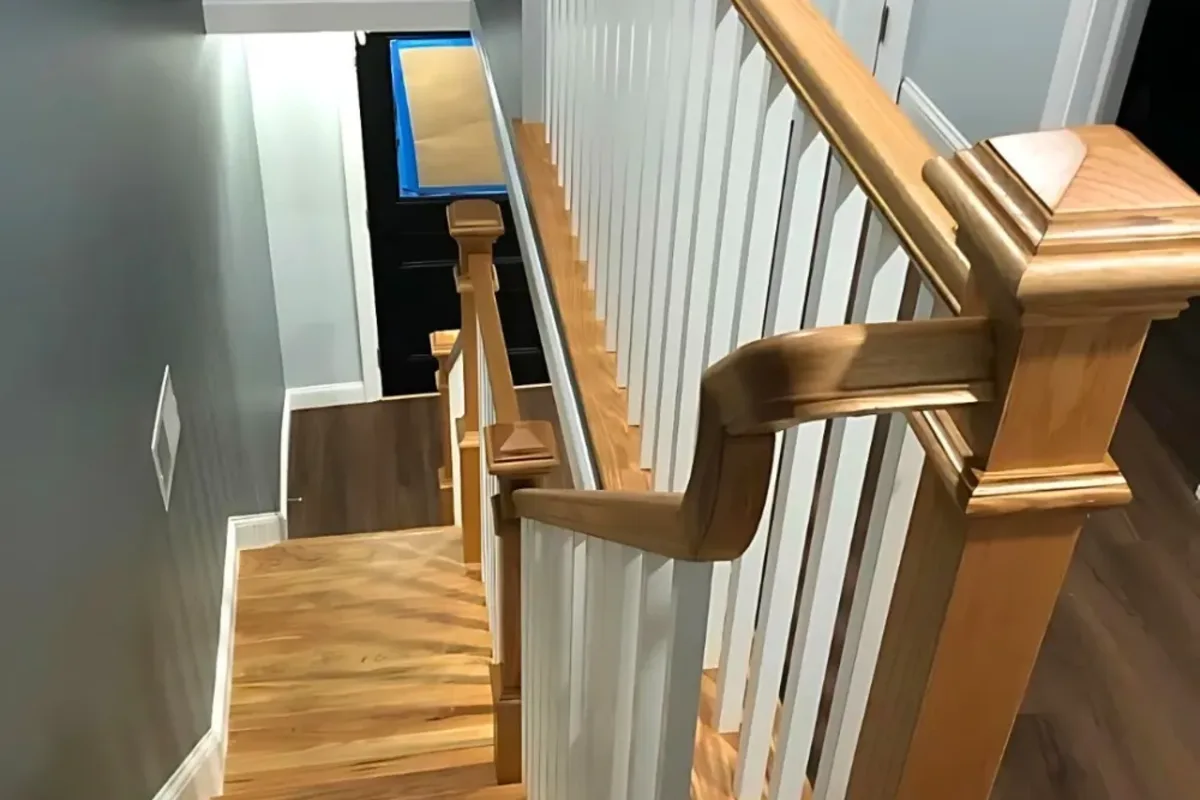
Lynnfield is one of the more affluent towns on the North Shore, and the housing stock reflects it: large colonials off Summer Street, custom homes near Sagamore Spring, mid-century capes that have been expanded over the decades, and newer builds in developments like Kimballs. A lot of these homes were finished with builder-grade staircases: carpeted treads, closed stringers, plain square balusters and an oak handrail that has yellowed over thirty years. The bones are usually fine, but the look is dated, and in a home that has been renovated everywhere else, the stairs become the thing that drags down the whole first floor.
The other big driver is safety and function. Older stairs in Lynnfield frequently have railings that are loose, spindles spaced too far apart for young kids, and treads that have worn slick. A stair remodel is a chance to bring everything up to current code while getting the design you actually want. When you are investing this kind of money into a North Shore home, a staircase that photographs beautifully and feels solid underfoot is a genuine return, both in daily enjoyment and in resale.
Stair remodeling styles that fit Lynnfield homes
There is no single right answer for a stair remodel, but certain looks tend to land well in Lynnfield's mix of traditional and transitional homes. Here are the directions we build most often.
Hardwood tread and riser refinishing
The most common starting point is pulling the carpet and replacing worn treads with solid hardwood. Red oak is the classic New England choice because it stains to match existing floors, but we also install white oak, maple and walnut for homeowners who want a specific tone. New solid treads with painted risers is a timeless colonial look that fits most Lynnfield homes and is the best value per dollar.
Open-riser and floating staircases
For homeowners doing a more contemporary renovation, open-riser stairs, where you can see through the gaps between treads, make an entry feel larger and brighter. These are popular in the newer custom homes on the north side of town. Open risers have specific code requirements around the size of the openings, which we cover below, so this is not a DIY-friendly style.
Curved and winder staircases
Some of the larger Lynnfield colonials and custom builds have room for a curved or sweeping staircase, which is the most dramatic upgrade you can make to an entry. Curved stringers and continuous handrails are skilled finish carpentry, and they are where an in-house crew really earns its keep. Winder stairs, which turn using pie-shaped treads instead of a landing, are also common in tighter Lynnfield layouts and have their own tread-depth rules.
Iron and glass railings
The single most impactful change to many Lynnfield staircases is the railing. Wrought-iron balusters, whether a simple straight bar, a hammered finish or a scroll pattern, instantly upgrade a plain oak stair. For contemporary homes, we install cable railings and tempered-glass panels that keep sightlines open. Iron and glass railings are premium finishes and are one of the reasons Lynnfield stair budgets run higher than the regional average.
Stair railing installation and Massachusetts code
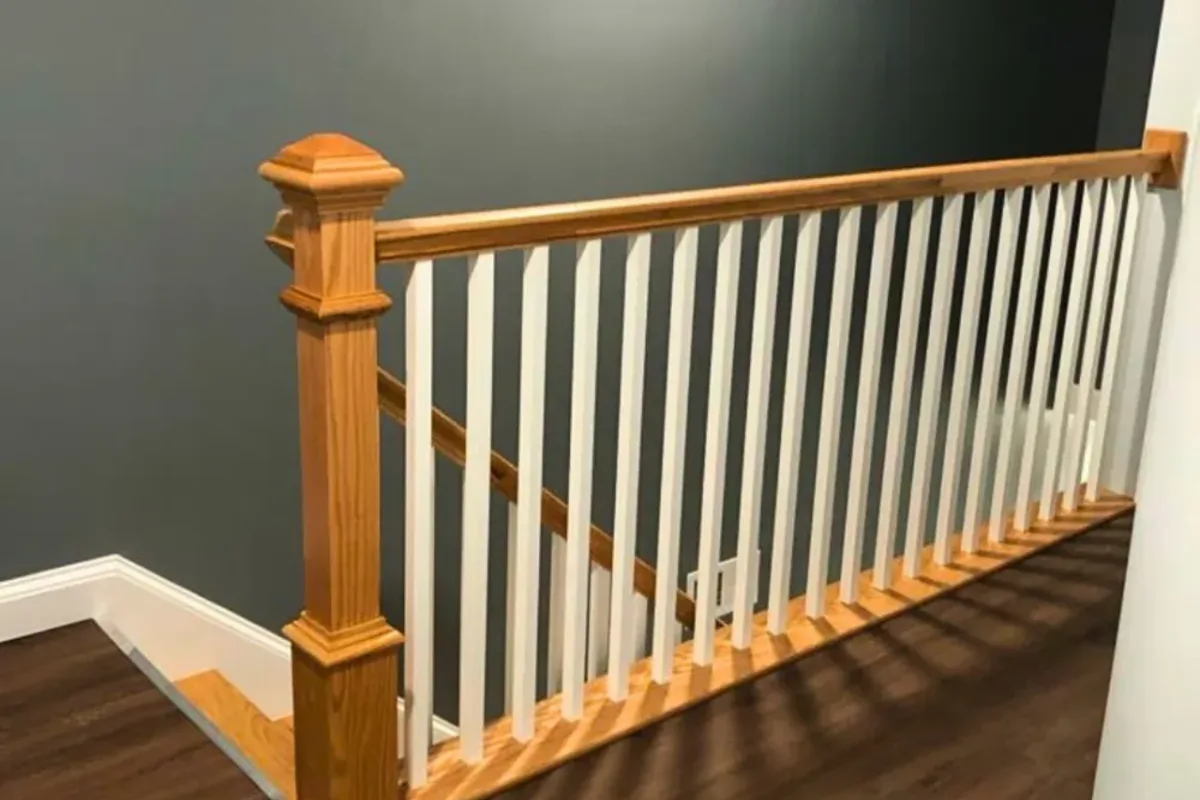
Stair railing installation is often the entire project, and it is the part most likely to be done wrong by a handyman. Massachusetts follows the state amendments to the International Residential Code, and stairs and railings are among the most heavily regulated parts of a home for good reason: falls on stairs are one of the most common serious injuries in a house. Here are the requirements that matter for a Lynnfield stair remodel.
- Handrail height: the top of the handrail must sit between 34 and 38 inches above the tread nosing.
- Graspable handrail: the handrail profile has to be something a hand can actually grip and continue around, not a wide flat cap.
- Baluster spacing: openings between balusters must be small enough that a 4-inch sphere cannot pass through, which keeps small children safe.
- Guard height: open sides of stairs and landings need a guard at least 34 inches high, and higher for elevated landings.
- Open riser limit: on open-riser stairs, the gap between treads cannot allow a 4-inch sphere through, which is why open risers require careful tread spacing.
These numbers are not negotiable, and a Lynnfield inspector will check them. When we install a railing, we build to code from the start, so there is no failed inspection and no rework. If you inherited a non-compliant railing, a remodel is the moment to fix it correctly.
Tread depth, riser height and headroom rules
Beyond the railing, the geometry of the stairs themselves is regulated. In Massachusetts residential work, the maximum riser height is 8.25 inches and the minimum tread depth is 9 inches, though most comfortable modern stairs use a taller tread. There are also rules about how consistent each step must be: risers within a single flight cannot vary by more than 3/8 inch, because uneven steps are a trip hazard. Minimum headroom over the stairs is 6 feet 8 inches. On older Lynnfield homes with tight stairwells, these dimensions sometimes conflict with the existing framing, and part of a good remodel is solving that puzzle without creating a step that feels wrong underfoot.
This is where experience pays off. Many of Lynnfield's older capes and colonials were built to older, looser standards, so an existing staircase may already violate today's rules with steps that are too steep or inconsistent. When we open up a staircase, we often find that the run and rise can be quietly improved within the existing framing, giving you a more comfortable, safer stair that also happens to bring the geometry into compliance. Where the framing simply will not allow full compliance, we discuss the realistic options with you honestly rather than papering over a problem the inspector will catch.
What a stair remodel costs in Lynnfield, MA
Costs vary widely because a stair remodel can be anything from swapping the balusters to rebuilding a full curved staircase. Treat the ranges below as Lynnfield-area planning numbers for licensed, insured, permitted work, not quotes. Lynnfield budgets tend to run at the higher end of these ranges because homeowners here typically choose premium materials and railings.
| Project type | Typical Lynnfield budget | What it usually includes |
|---|---|---|
| Railing refresh | $3,500 to $8,000 | New balusters, refinished or new handrail, keeping existing treads |
| Carpet to hardwood conversion | $5,000 to $12,000 | Remove carpet, install solid treads, paint risers, refinish or replace handrail |
| Full stair rebuild, standard | $12,000 to $25,000 | New treads, risers, stringers, iron or upgraded railing, refinishing |
| Open-riser or contemporary | $18,000 to $35,000 | Open risers, floating look, cable or glass railing, structural work |
| Curved or custom staircase | $30,000 and up | Curved stringers, continuous handrail, custom millwork, premium materials |
Where you land inside these ranges comes down to the material choices, the railing style and what we find once the old finishes come off. A straightforward baluster swap on a sound staircase is predictable. A full rebuild in a 1960s Lynnfield cape where the stringers have settled is a bigger scope, and we will tell you that before you commit.
What drives the price up or down
Understanding the cost drivers helps you steer your own budget. These are the factors that move a Lynnfield stair remodel the most.
- Railing material: wood balusters are the least expensive, wrought iron is mid to high, and glass or cable systems are the most expensive.
- Wood species: red oak treads cost less than white oak, walnut or custom-stained hardwoods.
- Structural condition: if the stringers, subfloor or landing framing need repair, that adds labor.
- Layout changes: converting a straight run to a curved or winder stair is a major cost step.
- Finish level: a simple stain versus a multi-step finish with fillers and lacquer changes the labor.
- Access and protection: a main-entry staircase in a finished Lynnfield home needs dust control and floor protection that a bare-bones job skips.
Materials that hold up in New England homes
Lynnfield's climate matters for a staircase more than people expect. New England humidity swings from damp summers to dry, heated winters, and wood moves with that cycle. Interior stairs are protected from the weather, but the wood still expands and contracts, which is why a poorly built staircase develops squeaks and gaps. We acclimate hardwood on site before installing, use the right fasteners and adhesives, and detail the treads so seasonal movement does not open up seams. For the railing, we favor solid hardwood handrails and iron balusters that stay tight through the seasons rather than hollow or particleboard components that loosen over time.
The stair remodeling process, step by step
A predictable process is what separates a clean stair remodel from a stressful one. Here is how we run a Lynnfield project from first call to final walkthrough.
1. On-site consultation
Iago comes out to your Lynnfield home, measures the existing stair, and talks through the look you want. We assess the framing, the current railing and any code issues before quoting anything.
2. Design and material selection
We help you choose tread species, stain color, riser treatment and railing style, matching the stair to your existing floors and trim so it looks original to the home rather than bolted on.
3. Detailed proposal
You get a written scope and price with the materials spelled out, so there are no surprises. If a permit is required, we handle it.
4. Demolition and prep
We protect your floors and contain dust, then remove carpet, old treads or the existing railing as needed.
5. Build and install
Our in-house crew installs stringers, treads, risers and railing, checking every dimension against code as we go.
6. Finish and inspection
We stain and finish the hardwood, coordinate the Lynnfield inspection when the permit calls for it, and do a final walkthrough with you before we consider the job done.
Permits and the Lynnfield Building Department
Whether your stair remodel needs a permit depends on scope. A pure cosmetic refinish or a like-for-like baluster swap often does not, but anything structural, such as rebuilding stringers, changing the run, altering a landing or reworking a guard, is regulated work that the Lynnfield Building Department will want to permit and inspect. The department is located at Lynnfield Town Hall on Summer Street, and they review residential building permits for exactly these kinds of alterations. As a licensed contractor holding HIC #212869, we pull the permit under our license, schedule the inspection, and make sure the finished stair passes on the first visit. Homeowners who let an unlicensed handyman skip the permit often find out at resale that the work was never inspected, which becomes a problem during the sale.
Timeline: how long a Lynnfield stair remodel takes
Most stair remodels are faster than a kitchen or bath, but the finish work takes patience. A railing-only project is often one to three days. A carpet-to-hardwood conversion with new treads and a stain runs roughly four to seven working days, with drying time for the finish built in. A full rebuild or a curved staircase can take two to four weeks depending on complexity and material lead times. Because the stairs are usually the only path to the second floor, we sequence the work so your family still has safe access throughout, and we never leave a Lynnfield home with an unusable staircase overnight.
Value and ROI of a stair remodel
In a town like Lynnfield, where buyers expect a polished home, the staircase carries outsized weight because it is front and center at the entry. A dated carpeted stair signals an unrenovated house; a clean hardwood stair with an iron or glass railing signals quality the moment someone walks in. While a staircase alone will not appraise like a kitchen, it dramatically improves showing quality and first impressions, which is exactly what drives offers on the North Shore. For homeowners staying put, the daily value of a solid, beautiful staircase that does not squeak or wobble is real and immediate.
Common stair remodeling mistakes to avoid
We are often called to fix stair work that went wrong the first time. The recurring problems are worth knowing before you hire anyone.
- Non-compliant railings: balusters spaced too wide or handrails at the wrong height that fail inspection or, worse, are unsafe.
- Squeaky treads: treads fastened without proper glue and screws that start creaking within a year.
- Mismatched stain: new treads that do not match the existing floors because the finish was rushed.
- Skipped permits: structural work done without a Lynnfield permit, which surfaces at resale.
- Wrong wood movement detailing: tight seams that gap open the first New England winter.
Refinishing versus full replacement
Not every stair needs to be torn out. If the stringers are sound and the layout works, refinishing existing treads and swapping the railing can deliver a dramatic change for a fraction of a rebuild. A full replacement makes sense when the structure has settled, the layout is awkward, or you are making a big style leap like going to open risers. Part of our consultation is telling you honestly which path your Lynnfield staircase actually needs, rather than upselling a full rebuild you do not require.
| Consideration | Refinish and re-railing | Full replacement |
|---|---|---|
| Best when | Structure is sound, you want a new look | Stringers settled or layout is changing |
| Typical cost | Lower | Higher |
| Timeline | A few days | One to several weeks |
| Design flexibility | Limited to existing footprint | Open risers, curves, new layout possible |
| Disruption | Minimal | Greater |
Choosing the right hardwood species for your treads
The wood you put underfoot sets the character of the whole staircase, and each species behaves differently in a Lynnfield home. Red oak is the workhorse: it is hard, widely available, takes stain evenly and matches the oak floors already in most North Shore colonials, which is why it remains our most common recommendation. White oak has a tighter, more contemporary grain and a naturally cooler tone that suits the transitional look many Lynnfield renovations are going for, though it costs more. Maple is smooth and pale with a subtle grain, excellent for painted or light-stained modern stairs, but it is harder to stain evenly, so it demands a skilled finisher. Walnut is the premium choice, a rich chocolate brown with no stain required, and it shows up in the higher-end custom homes on the north side of town. We walk you through samples in your own light, because a species that looks perfect in a showroom can read very differently against your specific floors and wall color.
Stain, finish and durability
How the wood is finished matters as much as the species. A staircase takes more foot traffic and abuse than almost any floor in the house, so the finish has to be tough. We build up multiple coats of a durable clear finish over the stain, sanding between coats, so the surface resists the scuffing that quickly dulls a cheap single-coat job. On stairs used daily by kids and pets, we often recommend a slightly higher-sheen, harder finish on the treads and a softer finish on the risers and railing for contrast. Matching the stain to your existing hardwood floors is where many jobs fail, because factory floor finishes and site-applied stains do not automatically line up. We custom-mix and test the stain on scrap from your project until it disappears into the existing floor, rather than fighting it.
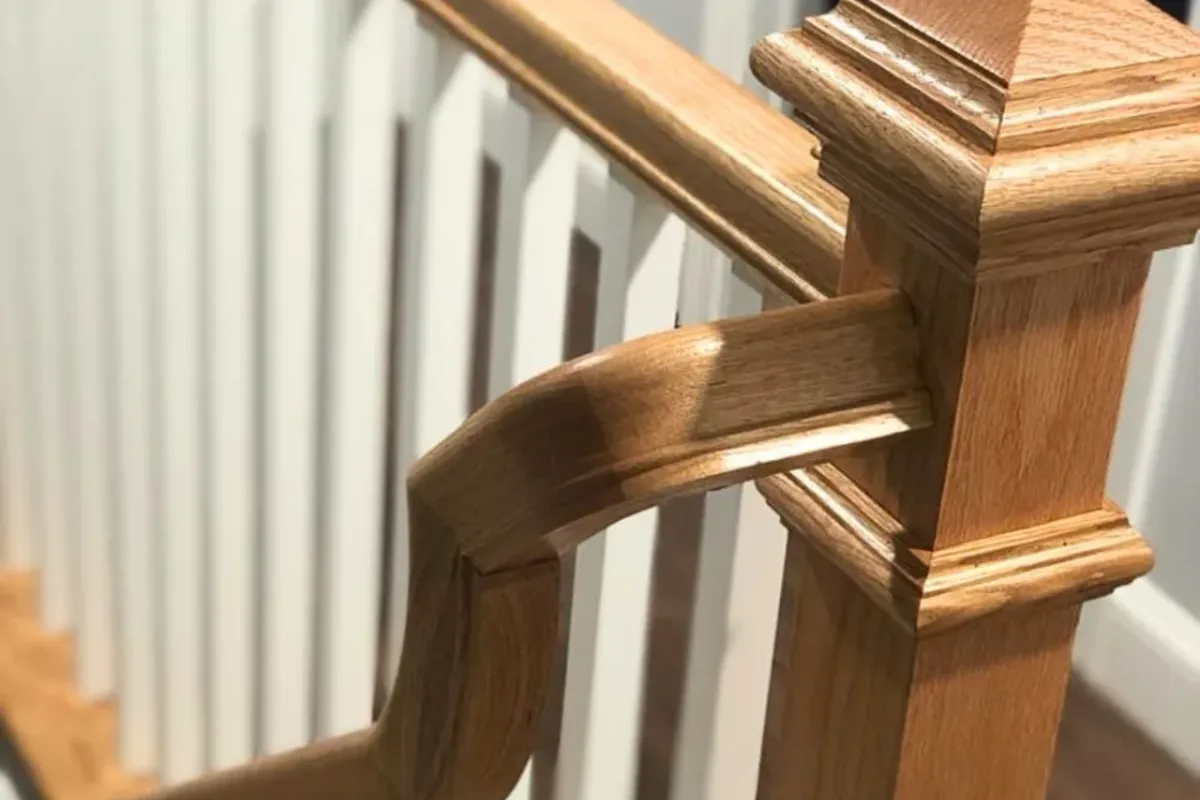
Newel posts, handrails and baluster patterns
The railing is a system of parts, and the way they are combined defines the style. The newel post is the anchor at the bottom and at each turn, and a substantial newel signals quality the instant you see the stair. Handrails range from a simple rounded profile to a wide, sculpted colonial rail, and the profile should match the formality of your Lynnfield home. Balusters set the rhythm: two square wood spindles per tread is the traditional look, while a single iron baluster per tread with a decorative center, or alternating plain and patterned iron, reads more current. For contemporary homes we run horizontal cable or a single continuous glass panel with a slim cap rail. Getting the proportion of these parts right, so nothing looks chunky or flimsy, is exactly the kind of judgment an experienced finish crew brings to the table.
Under-stair storage and space planning
Many Lynnfield homes have dead space under the main staircase that a remodel is the perfect time to reclaim. Depending on the layout, we can build custom drawers into the stair risers, add a closet or a mudroom bench beneath the run, or open the underside into an adjacent room to make it feel larger. In homes near the entry where storage is always tight, turning the under-stair void into functional space is one of the highest-value details we add, and it costs far less to plan into the remodel than to retrofit later. If your staircase is being rebuilt anyway, it is worth deciding what happens to the space beneath it while the structure is open.
Basement and exterior stairs
Stair remodeling is not only about the main entry stair. Plenty of Lynnfield projects involve finishing a basement staircase, replacing steep or non-compliant basement stairs with a safer run, or rebuilding exterior stairs and porch steps that have taken years of New England freeze-thaw. Basement stairs have the same code rules for riser height, tread depth and railing as the main stair, and inspectors do check them. Exterior steps add the challenge of weather: we use materials and details that handle water, ice and the ground movement that Lynnfield winters bring, so the steps do not heave or rot. If your project touches these secondary stairs, we handle them to the same standard as the showpiece staircase.
Accessibility and aging-in-place considerations
For Lynnfield homeowners planning to stay in their home for the long term, a stair remodel is a smart moment to build in accessibility. Continuous, easy-to-grip handrails on both sides, consistent riser heights, tread nosings that are easy to see, and good lighting all reduce fall risk as you age. We can also frame and prepare a staircase so a stair lift can be added cleanly later without tearing anything out. Thinking about these details during the remodel, rather than after a fall, keeps the staircase both beautiful and safe for the decades you plan to enjoy the home.
Matching your stair to the rest of the home
A staircase should look like it belongs. In a traditional Lynnfield colonial, that usually means stained oak treads, painted white risers, a warm handrail and either wood or iron balusters that echo the trim. In a contemporary renovation, it means cleaner lines, possibly open risers and a cable or glass railing. We pay attention to how the stair connects to your existing hardwood floors, your trim profiles and your paint colors, because a stair that clashes with the rest of the first floor undoes the whole point of the remodel.
Lighting and finishing details
The details are what make a high-end Lynnfield staircase feel custom. Recessed tread lighting or a wall of picture-frame wainscoting alongside the stair adds real polish. A statement newel post anchors the design. We also pay attention to the transition at the top and bottom landings, where cheap work usually shows first. These finishing touches are where an in-house finish crew separates itself from a general handyman.
Lighting deserves special mention in a Lynnfield home, because the entry staircase is often the first thing seen from the front door and the last thing seen at night. Low-level step lights improve safety on dark stairs and add a warm, upscale glow. A well-placed pendant or a small chandelier over an open stairwell turns the staircase into a focal point. Along the wall of the stair, a run of framed art, a gallery of family photos or wainscoting that follows the rake of the steps carries the design up the flight instead of leaving a blank wall. We plan these touches early so the wiring and blocking are in place before the finish work starts, which is far cleaner than adding them later.
How to choose a stair contractor in Lynnfield
Stairs are one of the easiest projects to get wrong and one of the hardest to fix after the fact, so who you hire matters. Before you sign with anyone for a Lynnfield stair remodel, confirm a few things. First, verify they hold a valid Massachusetts Home Improvement Contractor registration and carry liability insurance, because unlicensed work is both risky and a problem at resale. Ask whether the people doing the finish carpentry are employees or day-rate subcontractors, since railing and tread work is precision carpentry that rewards a stable, experienced crew. Ask how they handle permits and inspections with the Lynnfield Building Department, and be wary of anyone who suggests skipping the permit. Finally, ask to see stairs they have actually built, not stock photos. A contractor who is proud of their staircase work will happily show you tight miters, quiet treads and clean railing terminations. Innov Builders welcomes all of these questions, because they are exactly the standards we hold ourselves to.
Red flags and warning signs to watch for
A few warning signs should make any Lynnfield homeowner pause. A quote that is dramatically lower than everyone else usually means corners will be cut, often on the parts you cannot see, like fastening and glue. A contractor who cannot explain the handrail height and baluster spacing rules off the top of their head has probably never had a stair inspected. Reluctance to pull a permit for structural work is a serious red flag. Vague proposals that do not specify the wood species, stain and railing components leave room for cheaper substitutions later. And a crew that shows up without floor protection or dust containment in a finished home tells you how the rest of the job will go. Watching for these signs up front saves the far larger cost of tearing out and redoing a bad staircase.
How we work in occupied Lynnfield homes
Most of our stair remodels happen in homes where the family is still living there. We treat your home like it is ours: floor protection on the paths we use, dust containment around the work zone, daily cleanup, and clear communication about which parts of the stair are safe to use each day. Because the crew is in-house and led by Iago on site, you are dealing with the same people start to finish, not a project manager who hands you off to whoever is available.
Why choose Innov Builders in Lynnfield
Innov Builders is a licensed and insured general contractor holding HIC #212869 and OSHA certification, based at 50 New Salem St in Wakefield, minutes from Lynnfield. We build with our own in-house crew, so the carpenters and railing installers on your project are Innov employees who take pride in tight, quiet, code-correct stairs. Iago Maciel personally runs each project, from the first measurement to the final walkthrough, and we pull the proper permits with the Lynnfield Building Department so your remodel is done right and on the record. If you are planning a stair remodel or a stair railing installation in Lynnfield, we would be glad to walk your staircase with you and lay out honest options and pricing.
Serving Lynnfield and the North Shore
From our Wakefield shop we serve Lynnfield and the surrounding North Shore and Greater Boston towns, including Reading, North Reading, Woburn, Stoneham, Melrose, Saugus, Medford, Malden and Winchester. Being local means we know the housing stock, the inspectors and the climate, and we can be on your Lynnfield staircase quickly. To get started, call us at (978) 878-7977 or email contact@innovbuildersusa.com for a free on-site consultation and estimate.