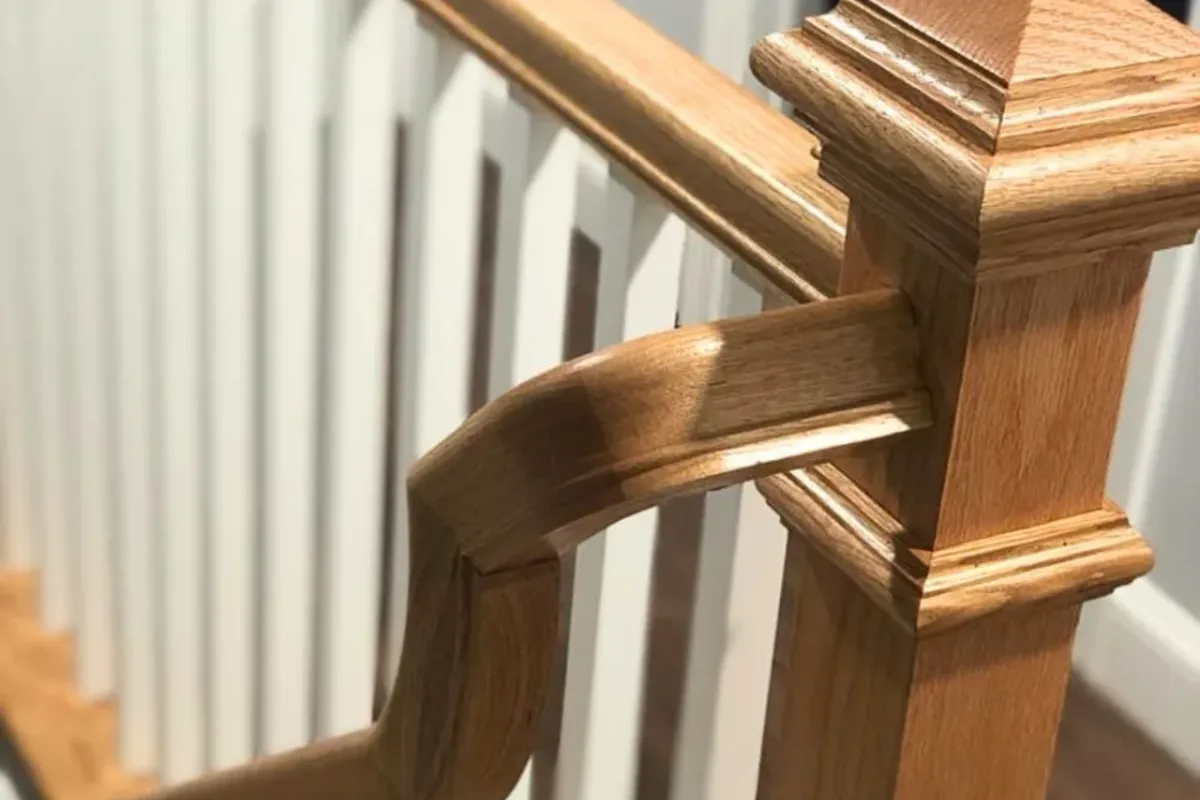
Innov Builders are the stair remodeling contractors Reading, MA homeowners call when a dated, creaky or unsafe staircase no longer fits the way they live in their home. From refinishing worn treads and swapping out a wobbly railing to a full staircase rebuild that meets current Massachusetts code, our in-house crew handles the design, the carpentry, the finish and any required permit from the first tread to the last baluster, so you work with one licensed team that owns the result instead of a rotating cast of subcontractors.
Reading sits just north of Wakefield, only a few minutes from our shop at 50 New Salem St, and it is a town built largely of older colonials, capes and Victorians with staircases that were framed generations ago. Those stairs are often the first thing a guest sees and the last thing a family updates, which is exactly why they end up with painted-over oak, mismatched spindles, an out-of-code railing height or treads that pop and squeak underfoot. This guide walks Reading homeowners through what a stair remodel really involves, what it costs here, how railings and balusters work under Massachusetts code, when to refinish versus rebuild, the permit process with the Reading Building Department, and how to choose a contractor who will still stand behind the work years from now.
Stair remodeling in Reading, MA: what the project really includes
A staircase remodel with Innov Builders in Reading covers far more than a fresh coat of stain. We start with a free on-site consultation at your home, inspect the framing and stringers under the stairs, check every rise and run with a level, and talk through how your family actually uses the space. From there we handle the full scope: design, the Reading building permit when the work is structural, careful demolition, any framing or stringer repair, new treads and risers, a code-compliant railing and baluster system, newel posts, skirt boards, and the finish work that decides whether the stairs look custom or look like a patch job. Because we are a licensed general contractor, we also coordinate flooring transitions, drywall repair and painting so the finished staircase blends into the rest of the home rather than standing out as an afterthought.
Every Reading staircase is different, but the goal never changes: a safe, beautiful stair that anchors the entry, adds real value to the home, and holds up to decades of daily traffic. On an older Reading colonial, that often means honoring the original scale and detailing of the house so the new stair reads as if it always belonged there.
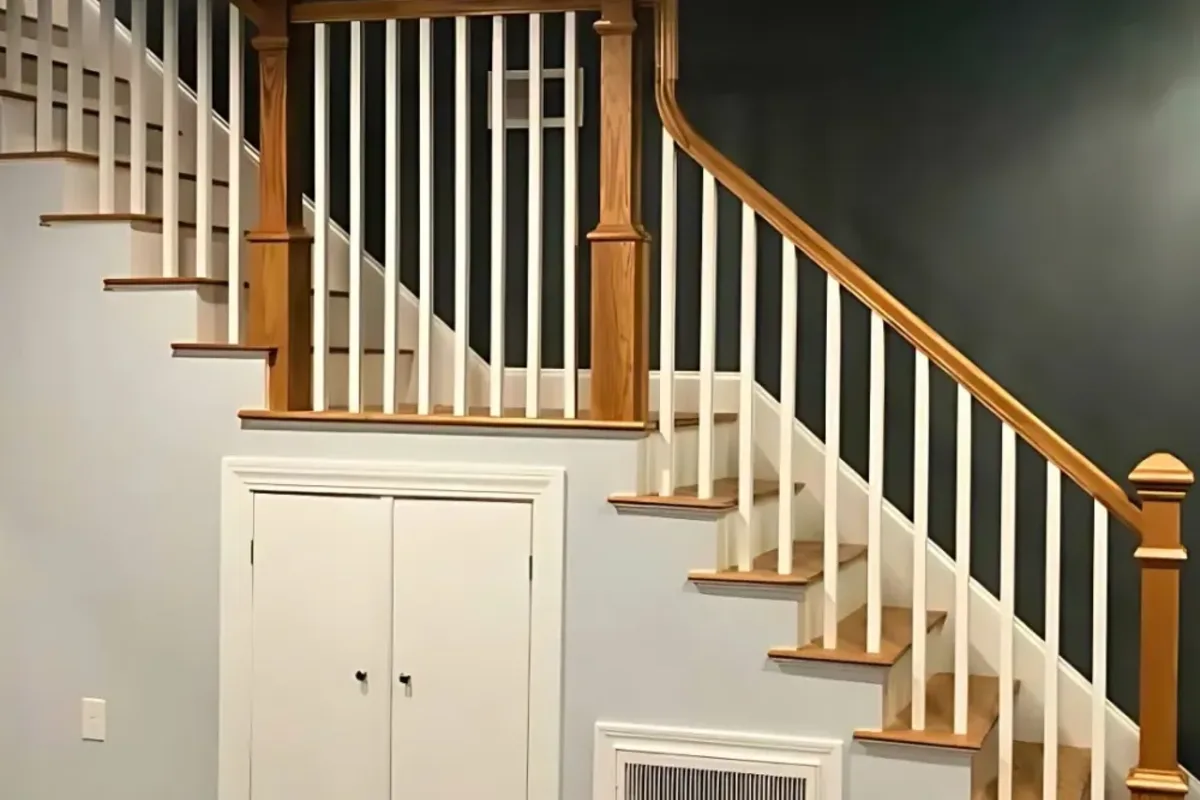
Why Reading homes are hard on staircases
The housing stock in Reading skews old, and that shapes almost every stair project we take on here. Many homes date to the early and mid twentieth century, with plenty of nineteenth-century colonials and Victorians mixed in along the older streets near the town center. These staircases were built by hand with materials and code standards that no longer match how families live today. We routinely find risers that are too tall, treads that are too shallow, railings mounted at heights that would never pass a modern inspection, and open sides with baluster gaps a small child could slip through.
New England seasons add their own stress. Reading winters push indoor humidity up and down as heating systems run, and that seasonal swing works joints loose over the years. A stair that was silent when the house was new develops the classic Reading squeak: a tread that has separated slightly from its stringer, or a wedge that has dried out and backed off. Decades of foot traffic wear a visible path into the center of each tread, especially on stained oak, and the finish thins right where hands and feet touch most. None of this means the staircase is beyond saving, but it does mean a Reading stair remodel is rarely just cosmetic. Doing it right means looking under the treads, not just over them.
Refinish, rebuild or replace: the honest choice for Reading homeowners
The first real decision on any Reading stair project is how far to take it. We walk every homeowner through three honest paths, because the right answer depends on what the structure underneath is actually doing, not on what will earn the biggest invoice.
Refinishing an existing staircase
If the stringers, treads and framing are solid and the problem is cosmetic, refinishing is the smart move. That covers stripping old paint or worn stain off oak or pine treads, sanding back to bare wood, filling minor gaps, re-staining or painting, and often swapping the railing and balusters for an updated look. Refinishing keeps the original structure that was framed into the house and delivers a dramatic visual change for a fraction of a full rebuild. Many older Reading colonials hide beautiful solid-oak stairs under decades of white paint, and bringing that back is one of the most satisfying updates we do.
Rebuilding the staircase
When the framing is sound but the treads, risers, railing or layout are worn out or out of code, a rebuild is the right call. We keep the stringers where they are structurally reliable and replace everything you see and touch: new treads and risers, new skirt boards, a new code-height railing with properly spaced balusters, and new newel posts anchored to the framing. A rebuild is where most Reading stair remodels land because it fixes safety and looks at the same time without moving walls.
Full replacement
If the stringers are cracked, the rise and run are unsafe, or you are changing the footprint during a larger renovation, a full replacement is warranted. This is the most involved path: we re-engineer the stair geometry to code, cut new stringers, and rebuild from the framing up. Full replacements are common when Reading homeowners open up a wall, finish a basement, or reconfigure an entry as part of a whole-home remodel.
We give every Reading homeowner an honest recommendation in writing. If a refinish will serve you well, we say so rather than pushing a rebuild you do not need.
Types of staircases we remodel in Reading
Reading homes are anything but uniform, and the style of your staircase shapes how we approach the remodel. Over the years we have rebuilt and refinished nearly every configuration this town has to offer.
Straight-run stairs
The most common layout in Reading capes and colonials, a straight flight from one floor to the next. These are the most straightforward to refinish or rebuild, and they are where a new railing makes the biggest visual difference for the money.
L-shaped and U-shaped stairs with landings
Many two-story Reading colonials use a stair that turns at a landing. The landing is a frequent trouble spot because the guard around it is often too low or missing entirely, and it takes careful carpentry to keep the rail continuous and graspable through the turn.
Winder and curved stairs
Older Reading homes and higher-end renovations sometimes feature winders, where the treads pie out around a turn, or a true curved stair. These demand re-engineered geometry so every tread is uniform and code-compliant, and they are the projects where in-house millwork really shows.
Basement and attic stairs
As Reading families finish basements and attics for extra living space, we are often asked to bring steep, utilitarian stairs up to code with proper rise and run, a real handrail and adequate headroom. These are frequently paired with a larger renovation and a Reading building permit.
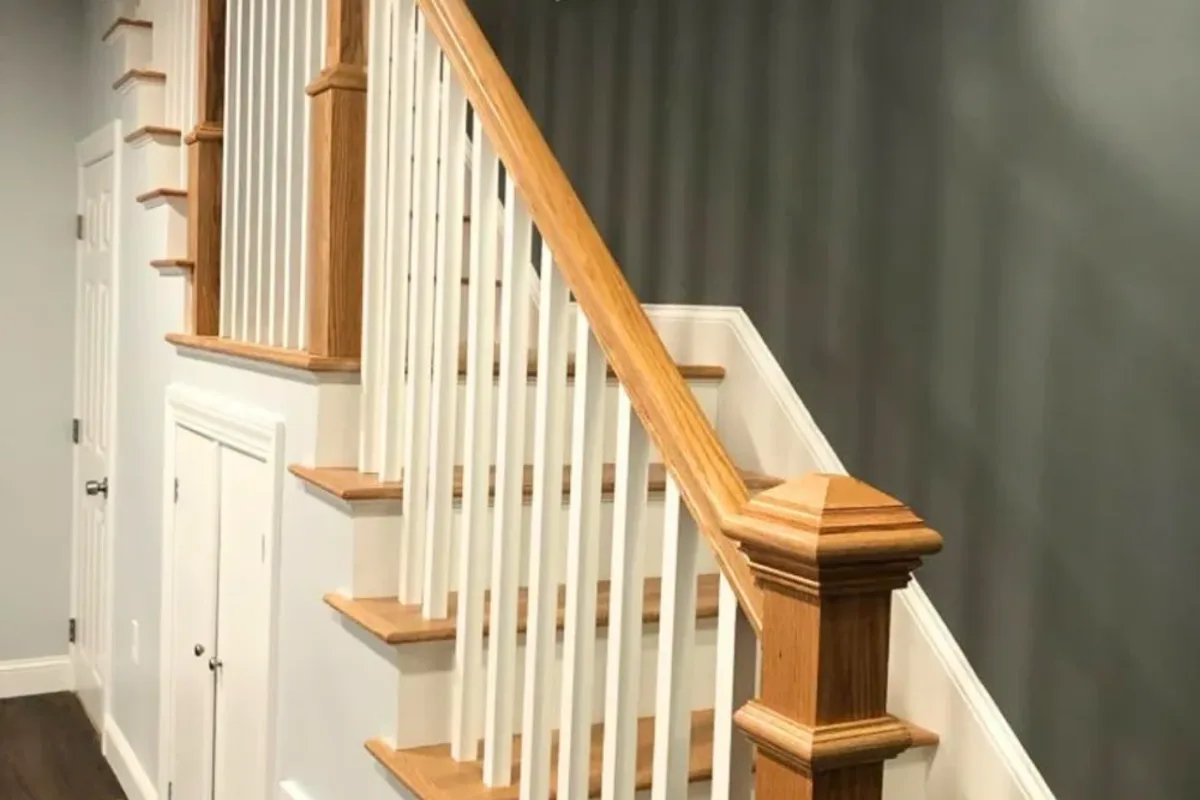
What a stair remodel costs in Reading, MA
Cost is the first question most Reading homeowners ask, and the honest answer is that it depends on scope, materials and the condition of what is already there. A cosmetic refinish is a very different project from a full code-compliant rebuild with a custom railing. The table below reflects the ranges we see on real Reading projects so you can gauge where your staircase is likely to land before we ever step on site.
| Project type | Typical Reading range | What it includes |
|---|---|---|
| Refinish treads and railing | $1,800 to $4,500 | Sand, stain or paint, minor repairs, refresh existing railing |
| New railing and balusters only | $2,500 to $6,500 | Code-height rail, new balusters, newel posts, finish |
| Full staircase rebuild | $6,000 to $14,000 | New treads, risers, railing, balusters, skirt boards, finish |
| Custom or curved staircase | $14,000 to $30,000+ | Re-engineered geometry, custom millwork, premium materials |
Several factors move a Reading stair project up or down within these ranges. Wood species matters, with red oak and poplar sitting well below hardwoods like white oak, maple or walnut. The railing system is often the single biggest swing: a simple wood rail costs a fraction of a wrought-iron baluster package or a glass-panel guard. The number of steps, whether the stair is open on one or both sides, and how much framing or stringer repair we find behind the finish all affect the final number. We give every Reading homeowner an itemized written estimate so you can see exactly what drives your price before any work begins.
Railings and balusters: the code that keeps your family safe
Stair railings and guards are not a design detail, they are a life-safety system, and they are where we see the most code violations in older Reading homes. Massachusetts follows the state building code that is based on the International Residential Code, and the numbers matter. Handrails on a stair must sit between 34 and 38 inches above the tread nosing. Guards along open sides of stairs and landings that are more than 30 inches above the floor below must be at least 36 inches high in most residential cases. The gap between balusters must be small enough that a 4-inch sphere cannot pass through, which is the rule that keeps small children from slipping between spindles.
Plenty of original Reading staircases fail one or more of these tests: a railing that is too low, spindles spaced too far apart, or a guard missing entirely at the top of a landing. When we remodel a staircase, we bring the entire railing and guard system up to current Massachusetts code, anchor newel posts into the framing so the rail cannot loosen, and make sure the handrail is graspable along its full length. It is the part of the job that never shows up in a magazine photo but matters most on a snowy Reading morning when someone is carrying groceries downstairs.
Railing material options for Reading staircases
Reading homeowners have real choices when it comes to the look and feel of a new railing, and the right one depends on the age and style of the house.
- Traditional wood: stained or painted oak, poplar or maple rails and balusters that suit the colonials and capes common in Reading. Warm, classic and endlessly repairable.
- Wrought iron balusters: a popular update that keeps a wood rail and newel but swaps spindles for iron, giving an older Reading home a lighter, more open feel with strong durability.
- Mixed metal and wood: a wood handrail paired with slim metal balusters, a transitional look that fits renovated Reading homes without clashing with original trim.
- Glass panel guards: tempered glass that maximizes light and views, best suited to contemporary or heavily renovated Reading interiors.
Materials that hold up in a Reading home
Because Reading houses swing through humid summers and dry heated winters, material choice on a staircase is about more than looks. Solid hardwood treads, most often red or white oak, remain the standard for durability and refinishing life; a solid oak tread can be sanded and re-stained several times over its life, which matters on a stair that sees traffic every day. Poplar is a cost-effective, paint-grade option for risers and painted stairs. Maple offers a tighter grain and a cleaner modern look but shows every dent, so we steer it toward lower-traffic Reading stairs.
For railings, kiln-dried hardwood resists the seasonal movement that loosens joints, and properly anchored newel posts are what keep a rail solid for decades. We avoid finger-jointed or soft materials in high-touch areas because they telegraph every seasonal swing in a New England home. The finish is just as important as the wood: a durable polyurethane or hardwax-oil finish protects treads from the grit tracked in off Reading sidewalks and salted winter walks, and it is far easier to refresh down the road than a cheap film finish that chips.
Permits and the Reading Building Department
Whether your stair project needs a permit depends on scope. A pure cosmetic refinish, sanding and re-staining treads or repainting an existing rail, generally does not require one. But once the work becomes structural, replacing stringers, rebuilding the staircase, or altering a railing or guard that is part of the life-safety system, the Town of Reading requires a building permit through the Reading Building Department, located at Reading Town Hall on Lowell Street. As a licensed general contractor, Innov Builders pulls the permit under our HIC registration, schedules the inspections, and makes sure the finished stair meets the Massachusetts State Building Code before it is signed off.
This is not red tape for its own sake. A permitted, inspected staircase protects you on resale, because a Reading buyer's inspector will flag an out-of-code railing or an unpermitted structural change. It also protects your family, since the inspection confirms the rail height, baluster spacing and framing are actually right, not just close. We handle the paperwork so you never have to stand in line at Town Hall, and we keep the records so you have proof the work was done to code.
Our stair remodeling process, step by step
Reading homeowners tell us the worst part of hiring a contractor is not knowing what happens next. Here is exactly how an Innov Builders stair remodel runs, from the first call to the final walkthrough.
1. Free on-site consultation
We come to your Reading home, look at the staircase from above and below, check the rise and run, and listen to what is bothering you, whether it is a squeak, a shaky rail or a dated look. We talk through refinish versus rebuild honestly and take measurements.
2. Design and written estimate
You get an itemized, written estimate that spells out materials, railing style and scope, with no vague lump sums. We help you choose treads, railing and finish that fit your home and budget.
3. Permit and scheduling
When the work is structural, we pull the Reading building permit and schedule the job around your family, including protecting adjacent floors and walls before demolition begins.
4. Demolition and structural work
We remove the old treads, risers and railing, inspect and repair the stringers and framing, and eliminate the squeaks at the source instead of hiding them.
5. Build and finish
New treads, risers, skirt boards, railing, balusters and newel posts go in, followed by careful sanding, staining or painting, and any drywall and flooring transitions so the stair blends into the home.
6. Inspection and walkthrough
We schedule the town inspection where required, then walk the finished staircase with you to make sure every detail meets the standard we promised.
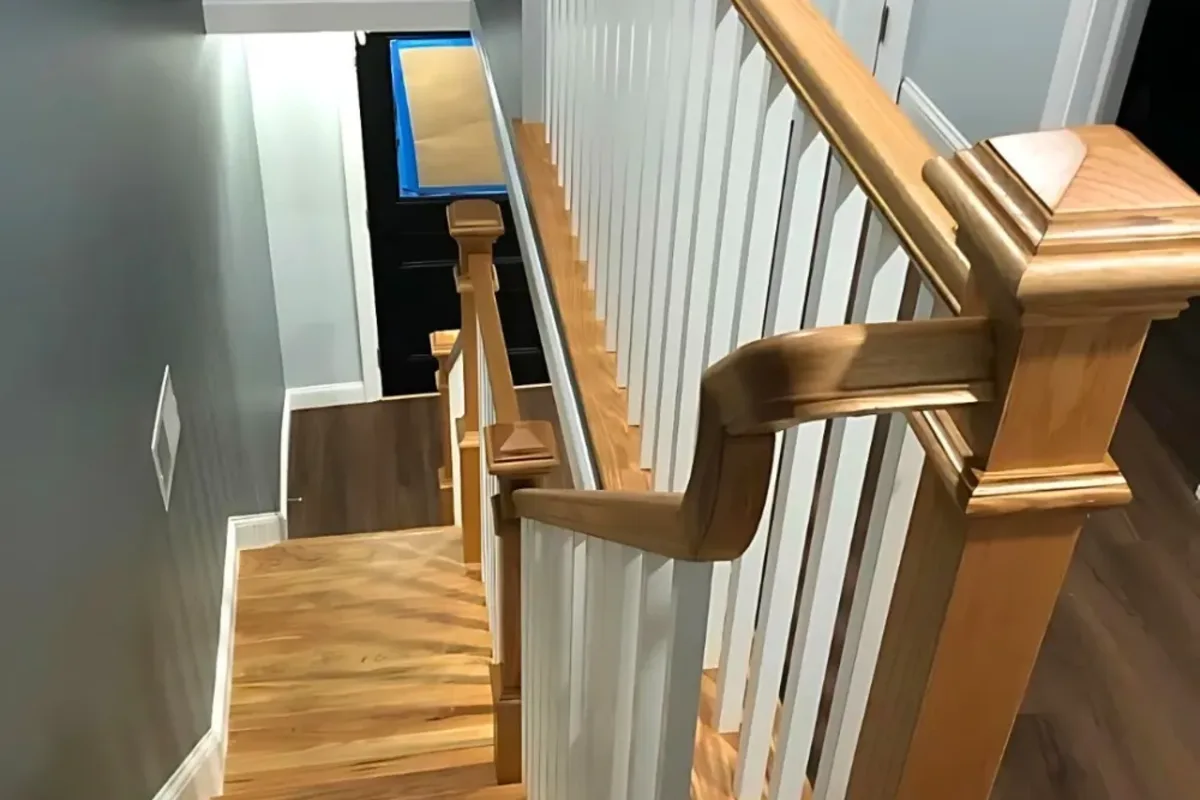
Stair railing installation in Reading: a project of its own
Not every Reading homeowner needs a full stair remodel. Sometimes the treads are fine but the railing is the problem: a rail that wobbles when you lean on it, spindles that a toddler can slip between, or an open landing with no guard at all. Stair railing installation is one of the most common and highest-impact projects we do in Reading, and it delivers an outsized safety and style return for the cost.
A proper railing installation is more than screwing a rail to the wall. We anchor newel posts into the stair framing so the whole system is rigid, set the handrail at the correct 34 to 38 inch height, and space balusters so no 4-inch gap remains. On an open-sided stair we build a guard to the full 36-inch height. For wall-mounted handrails, we hit the studs and use brackets rated for real load, because a handrail is only useful if it holds when someone actually grabs it. Whether you want to keep a traditional wood rail, update to wrought-iron balusters, or move to a mixed metal-and-wood look, we install it to code and finish it so it looks original to your Reading home.
Comparing your railing and stair options
To help Reading homeowners weigh the trade-offs, here is how the most common stair and railing choices stack up on cost, durability and the kind of home they suit best.
| Option | Relative cost | Durability | Best for |
|---|---|---|---|
| Refinish existing wood stair | Low | High if structure is sound | Older Reading colonials with solid oak stairs |
| Wood rail with wood balusters | Low to medium | High, fully repairable | Traditional capes and colonials |
| Wood rail with iron balusters | Medium | Very high | Updated traditional and transitional homes |
| Full rebuild with custom millwork | High | Very high | Whole-home renovations and open floor plans |
| Glass panel guard | High | High | Contemporary or heavily renovated interiors |
Stair lighting, runners and finishing touches
The details that make a Reading staircase feel finished often come at the end, and because we are a licensed general contractor we can handle them in the same project rather than sending you to another trade. Recessed step lights or a lit handrail add real safety on a dark stairwell and a high-end look for very little cost, and we run the wiring to code as part of the build. A stair runner, a strip of carpet down the center of wood treads, softens sound, adds grip on a slick refinished stair, and suits the traditional look of many Reading colonials. We also handle the skirt boards, the wall trim alongside the stringers, and the transition where the stair meets the floor above and below, so the whole assembly reads as one clean piece of millwork rather than a stair dropped into a gap.
Staircase safety for families and aging in place
Beyond code, a lot of Reading homeowners remodel a staircase for a very personal reason: someone in the household is aging, or there are young children on the stairs every day. Safety-minded upgrades we build into Reading stair projects include a graspable handrail that runs the full length of the flight on both sides where space allows, closed risers so a foot cannot slip through, treads with adequate depth and a consistent rise so there are no surprise steps, slip-resistant finishes, and lighting that eliminates dark spots. For homeowners planning to stay in their Reading home for the long run, these choices turn a staircase from a daily worry into something you never have to think about, which is exactly how a stair should feel.
Timeline: how long a Reading stair remodel takes
Most Reading stair projects move faster than homeowners expect, though the exact timeline depends on scope and finish. A straightforward refinish of treads and a railing refresh typically runs three to five working days, including drying time between coats of stain or paint. A full staircase rebuild with new treads, risers and a code-height railing usually takes one to two weeks on site. Custom or curved staircases, or stairs tied into a larger Reading renovation, run longer because of millwork lead times and additional framing. We give you a realistic schedule up front, sequence the work so your family can still use the home, and stick to the dates we commit to.
Stair remodeling as part of a larger Reading renovation
A staircase remodel rarely happens in a vacuum. In Reading we most often rebuild or refinish stairs as part of a bigger project: a homeowner refinishing floors throughout the house wants the treads to match, a family finishing a basement needs the stairs down brought to code, or a kitchen or entry renovation opens up sightlines that suddenly make a dated railing look worse. Because Innov Builders is a full general contractor, we fold the staircase into the larger scope instead of leaving you to coordinate separate trades. That means the stair finish matches your new floors, the demolition and dust control are planned around the whole job, and one crew and one schedule cover everything. If you are already investing in your Reading home, timing the staircase with the rest of the work almost always saves money and produces a more cohesive result.
Return on investment: what a stair remodel adds to a Reading home
The staircase is one of the highest-visibility features in a home, usually front and center the moment you walk through the door, so a well-executed remodel returns value out of proportion to its cost. In the Reading market, buyers respond strongly to a bright, safe, updated staircase, and a dated or unsafe stair is one of the first things a buyer's inspector and a real estate agent will call out. Refinishing hidden oak treads or replacing a low, spindly railing with a clean code-compliant system modernizes the entire feel of an older Reading colonial for a modest investment. Beyond resale, the daily value is real: no more squeaks, no more white-knuckling an icy trip downstairs, and an entry you are proud to show guests.
Matching a new stair to an older Reading home
One of the hardest parts of remodeling a staircase in Reading is making the new work look like it belongs. A stair that is technically perfect but obviously new can cheapen a well-kept colonial. Our approach is to read the house first: the profile of the existing trim, the scale of the newel posts, the width of the treads and the character of the original millwork. On a period Reading home we often reproduce a traditional turned newel and a rounded handrail profile rather than dropping in a modern off-the-shelf kit. When a homeowner wants a cleaner, updated feel, we bridge old and new deliberately, keeping a wood handrail that echoes the original trim while introducing slim iron balusters, so the change reads as intentional rather than mismatched. The result is a staircase that looks original from the entry but performs to today's standard underfoot.
Refinishing hidden hardwood in a Reading colonial
One of the most rewarding projects we do in Reading is uncovering solid oak that has been buried under decades of paint. Many mid-century and older Reading colonials were built with beautiful hardwood treads that a previous owner painted white or covered with carpet and a metal nose strip. When the wood underneath is intact, refinishing brings the entire entry back to life at a fraction of a rebuild. The process is careful work: we test for lead paint before sanding, which is common in Reading homes built before 1978, contain the dust, strip and sand the treads back to bare wood, repair any chips or splits, and re-stain or clear-coat to highlight the grain. Because these stairs see daily traffic, we finish with a durable penetrating or hardwax-oil coat that stands up to grit and salt tracked in over a Reading winter and refreshes easily years later. Not every painted stair hides oak worth saving, so we always check before we promise, but when it is there, the transformation is dramatic.
Common mistakes we fix on Reading staircases
Because we work on so many older Reading homes, we see the same avoidable problems again and again, usually from previous do-it-yourself work or a rushed contractor.
- Railings mounted too low: a rail below 34 inches fails inspection and offers less protection, especially on the steep stairs common in older Reading homes.
- Balusters spaced too far apart: gaps wider than 4 inches are a genuine hazard for small children and a guaranteed inspection failure.
- Squeaks covered instead of cured: shims and construction adhesive hide a squeak for a season, but the fix is re-securing the tread to the stringer from below.
- Newel posts anchored to trim, not framing: a newel that is only screwed to the skirt board will always feel loose. It has to tie into the structure.
- Film finishes on high-traffic treads: a cheap film finish chips and wears a path in a year. A penetrating or hardwax-oil finish holds up to Reading foot traffic.
How to choose a stair remodeling contractor in Reading
A staircase touches both the look of your home and the safety of everyone who uses it, so the contractor you pick matters. Ask any Reading stair contractor for their Massachusetts Home Improvement Contractor registration and proof of insurance before you sign anything. Ask whether they use their own carpenters or subcontract the work out, because a stair is a craft trade and a rotating subcontractor rarely owns the outcome. Ask how they handle railings and guards to code, and whether they pull permits for structural work. And ask to see finished stairs, not just before photos.
Innov Builders checks every one of those boxes. We are a licensed and insured general contractor, HIC #212869, OSHA certified, led by Iago Maciel and staffed by an in-house crew, not rotating subcontractors. We work out of 50 New Salem St in Wakefield, minutes from Reading, and we treat every staircase, from a simple refinish to a full custom rebuild, as a reflection of our name.
Why an in-house crew matters on a staircase
A staircase is one of the few projects in a home where the framing carpenter, the finish carpenter and the painter all have to work in tight sequence on the same small structure. When those trades are handed to rotating subcontractors, the seams show: a newel that never quite lines up with the finish, a stain that does not match the trim, a squeak that comes back because nobody owned the framing. Innov Builders runs the whole project with our own crew, so the person who sets the stringers is coordinating with the person who hangs the railing and the person who lays the finish. That continuity is why our Reading staircases feel solid and look seamless. It also means one point of accountability: if anything is not right, you call us, not a chain of subcontractors pointing at each other.
Keeping your Reading home livable during the remodel
A staircase is not a room you can simply close off, it is the artery between floors, so how a contractor sequences the work matters to daily life. On most Reading stair projects we plan the demolition and rebuild so your family retains safe access as long as possible, protect adjacent floors and walls with dust barriers and coverings before we start, and clean up thoroughly at the end of each day. For a full rebuild that requires the stair to be out of service for a stretch, we tell you exactly how long up front and schedule around your household. We also contain sanding dust carefully, which matters in Reading homes where lead paint may be present, and we keep the site tidy because we are working in the most visible part of your home, not a back bedroom.
Serving Reading and the North Shore
Reading is home turf for us. From our Wakefield shop we are a short drive to every neighborhood in town, which means faster response, easier follow-up and a crew that knows the local building office. Beyond Reading, we remodel staircases across the North Shore and Greater Boston, including North Reading, Lynnfield, Woburn, Stoneham, Melrose, Saugus, Wakefield, Medford, Malden and Winchester. Wherever you are in the area, you get the same licensed team and the same standard of work.
Ready to remodel your Reading staircase?
If your Reading staircase squeaks, wobbles, looks dated, or would not pass a modern inspection, Innov Builders can help you decide the smartest path and build it right. Call us at (978) 878-7977 or email contact@innovbuildersusa.com to schedule a free on-site consultation and an honest, itemized estimate for your home. One licensed team, one crew, one staircase built to last.