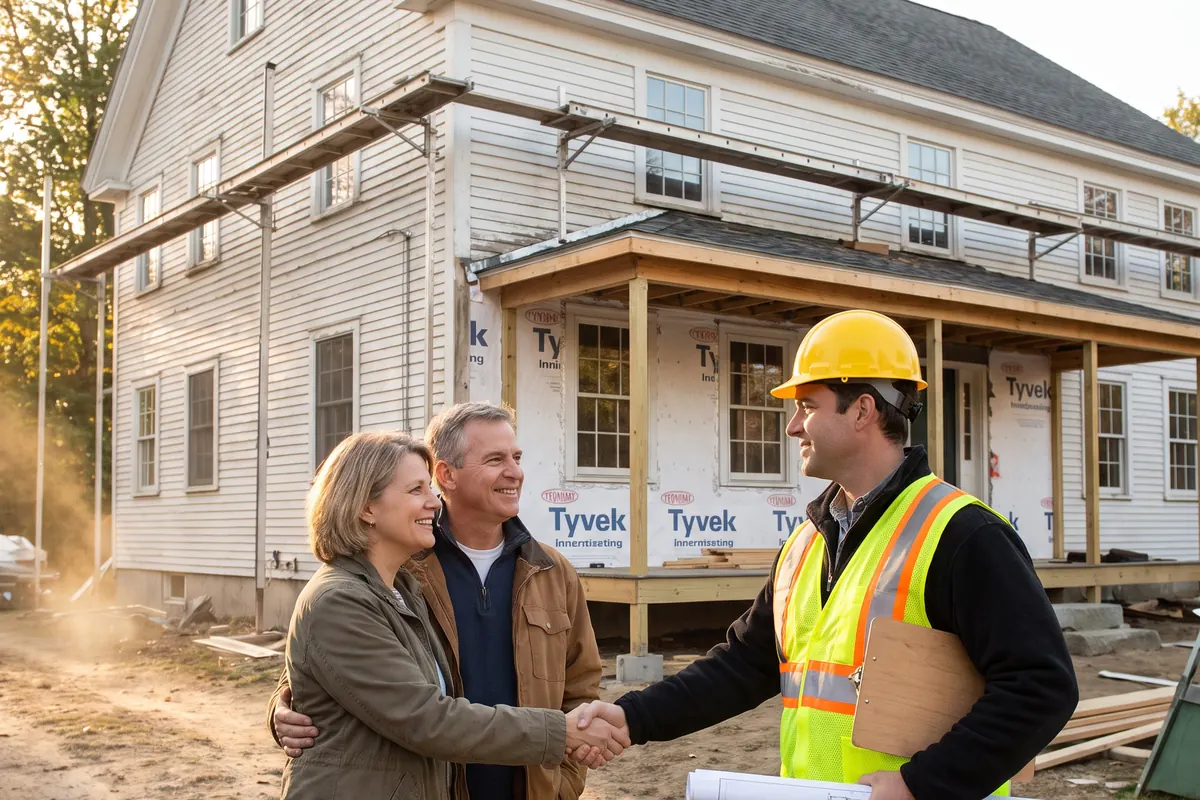
Innov Builders are the stair remodeling contractors Woburn, MA homeowners call when a staircase feels dated, unsafe, or simply out of step with the rest of a renovated home. A staircase is the one feature nearly everyone in the house touches every single day, and it sits at the center of your entry, so when the treads squeak, the balusters wobble, or the finish has worn through, it drags down the whole first impression. We rebuild, refinish, and re-rail staircases across Woburn with an in-house crew, a licensed and insured general contractor behind every job, and a real respect for how New England homes are built.
This guide walks through everything a Woburn homeowner should understand before starting a stair remodel: the types of projects, what drives the price, materials that hold up here, code requirements in Massachusetts, permits through the Woburn Building Department, a realistic timeline, and how to tell a good stair contractor from a risky one. It is written to help you plan, not to pressure you into anything.
Why stair remodeling matters more in Woburn homes
Woburn sits about five miles south of our shop at 50 New Salem St in Wakefield, an easy run down Route 128 or Washington Street, so we work in Woburn constantly. The city has an unusually wide mix of housing stock: tight streets of late-1800s Victorians and workers cottages near the old tannery district and Montvale Avenue, big Colonial Revivals and Capes through the West Side and Four Corners, mid-century ranches and splits out toward Horn Pond, and newer construction near the developments off Washington and Cambridge Road. Each of those eras built stairs differently, and that history shows up the moment we open a project.
Older Woburn homes often have narrow, steep staircases with closed stringers, painted treads worn to bare wood, and handrails that were never bolted properly to begin with. Ranches and splits tend to have exposed basement stairs and short flights that were treated as an afterthought. Whatever the vintage, a well-executed stair remodel does three things at once: it makes the busiest path in your house safer, it modernizes the look of the entry, and it protects one of the highest-visibility features a buyer sees during a walkthrough. In a competitive Woburn market, a tired staircase quietly tells buyers the rest of the house was neglected, even when it was not.
The main types of stair remodeling projects
Stair remodeling is not one job, it is a family of jobs that range from a one-day facelift to a full structural rebuild. Knowing which one you actually need is the first step to a realistic budget in Woburn.
Refinishing treads and risers
The most common request we get in Woburn is refinishing: sanding worn or painted hardwood treads back to bare wood, repairing gouges, and applying a durable stain and polyurethane finish. Risers are usually painted a clean white or a contrasting color. Refinishing keeps the existing structure and geometry, so it is the fastest and most affordable route when the stairs are structurally sound but simply look tired.
Tread replacement and stair capping
When the original treads are carpeted particleboard or pine that is too damaged to refinish, we install new solid hardwood treads, either replacing them outright or capping the existing structure with prefinished retro-fit treads and matching risers. This is how a lot of Woburn homeowners convert an old carpeted staircase into a clean hardwood run without tearing the framing apart.
Railing, baluster, and newel post work
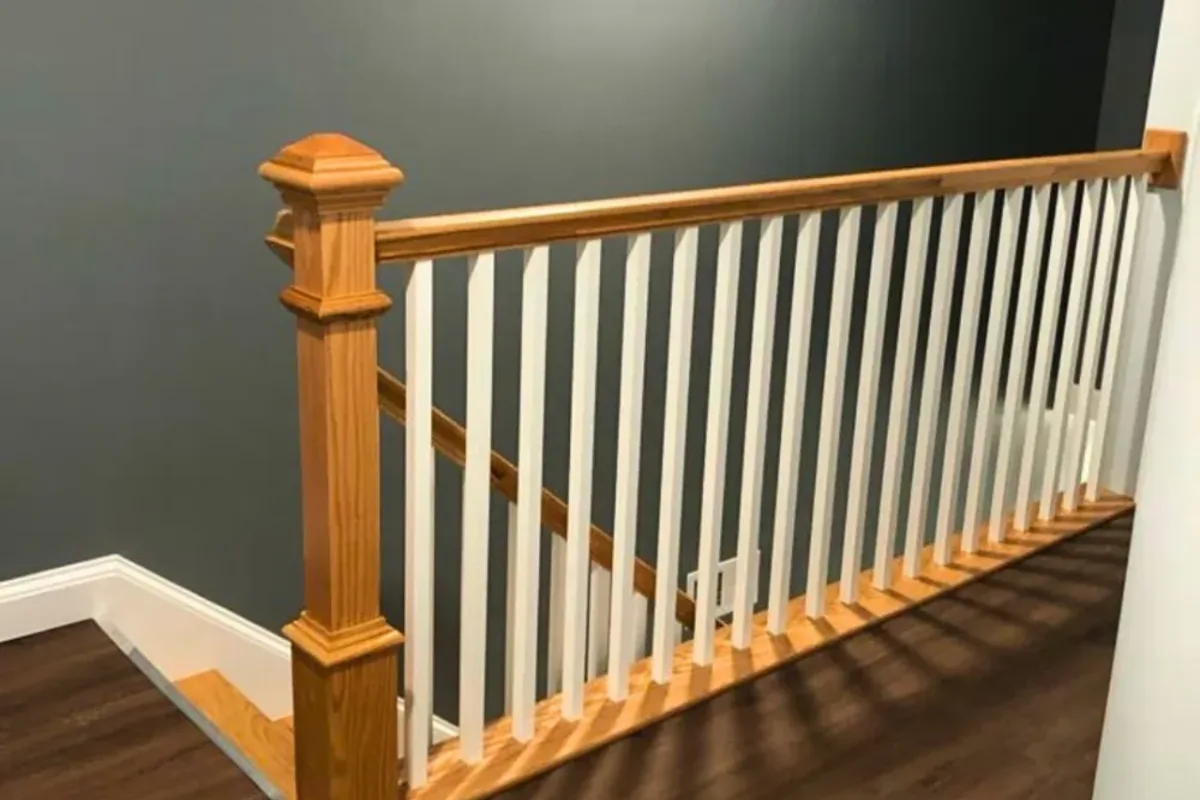
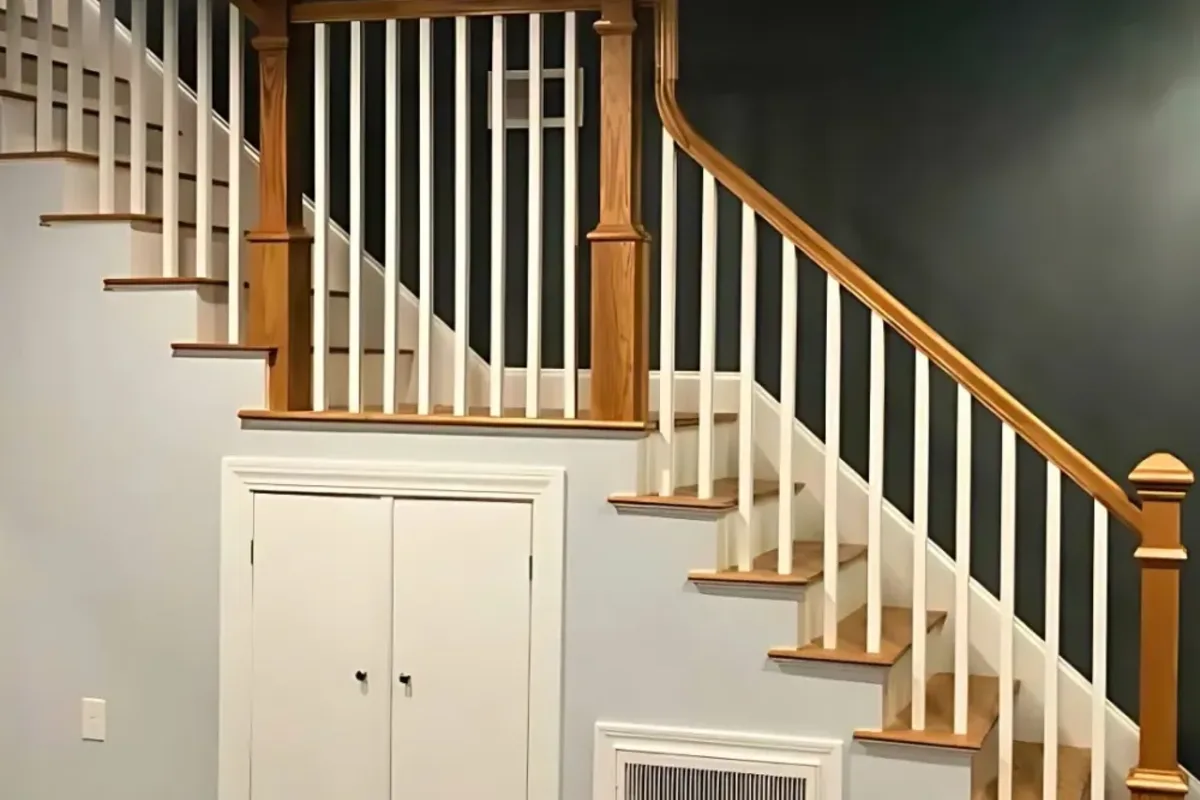
Handrails and balusters are the single biggest visual change you can make. We swap wobbly wood spindles for iron balusters, replace undersized or damaged handrails, and re-anchor or replace newel posts so the whole system feels solid. This is also where code matters most, which we cover in detail below.
Full staircase rebuild
Sometimes the stairs are past saving: rotted stringers, treads pulling loose, a rise or run that never met code, or a layout that needs to change during a larger renovation. A full rebuild means new stringers, treads, risers, railings, and often a reconfigured landing. It is the most involved project, but it is also the moment to fix everything that was wrong from day one.
Stair railing installation on new or open stairs
Not every stair railing installation is part of a remodel. Open basement stairs, a deck-to-house transition, or a newly framed staircase in an addition all need a code-compliant railing where there was none. We handle stair railing installation as a standalone project too, matching the new rail to the style and finish of the rest of your Woburn home.
Stair remodeling cost in Woburn, MA
Every staircase is different, so treat these as planning ranges for a licensed, insured, permitted job in the Woburn area, not a quote. The final number depends on the length of the flight, the materials, the railing system, and what we find once the old finish or carpet comes off.
| Project type | Typical range | What it usually includes |
|---|---|---|
| Refinish treads and risers | $1,500 to $3,500 | Sanding, repairs, stain and polyurethane on treads, painted risers, same structure |
| New hardwood treads or capping | $3,000 to $6,500 | Solid or retro-fit hardwood treads, matching risers, removal of old carpet or worn treads |
| New railing and iron balusters | $3,500 to $8,000 | Handrail, balusters, newel posts, anchoring, code-compliant spacing and heights |
| Combined refinish plus new railing | $6,000 to $12,000 | Full cosmetic transformation: treads, risers, railing, balusters, newels, finish |
| Full staircase rebuild | $9,000 to $20,000 or more | New stringers, treads, risers, railing system, landing, permit, structural work |
Why the wide spread? Because refinishing an intact flight of thirteen straight treads is a very different job from rebuilding a winder staircase with a mid-flight landing and a curved iron railing. Scope drives the price, and the honest way to narrow it down is a walkthrough where we can actually see the stringers, the framing, and the condition behind the carpet.
What moves the price up or down
- Number of treads and flights. A single straight run is cheaper per step than a split staircase with a landing or winders.
- Railing complexity. A simple wall-mounted handrail costs far less than an open railing with iron balusters, volutes, and multiple newels.
- Material choice. Red oak is the value workhorse; white oak, maple, and stained-to-match species cost more.
- Hidden damage. In older Woburn homes we sometimes find split stringers, past water damage near a leaky wall, or squeaks that mean re-securing every tread from below.
- Layout changes. Moving a staircase or changing the rise and run during a larger remodel adds framing and permit scope.
Massachusetts stair code every Woburn homeowner should know
Stairs are one of the most heavily code-regulated parts of a house, and for good reason: falls on stairs are among the most common serious home injuries. Massachusetts follows the state building code (currently based on the International Residential Code with Massachusetts amendments), and the Woburn Building Department enforces it. The details below are the ones that matter most on a residential remodel, and they are exactly the standards our crew builds to.
- Riser height: a maximum of about 8 1/4 inches, with the difference between the tallest and shortest riser in a flight kept within 3/8 inch. Uneven risers are a leading cause of trips.
- Tread depth: a minimum of about 9 inches, again kept consistent across the flight.
- Handrail height: between 34 and 38 inches, measured from the tread nosing.
- Guardrail height: at least 36 inches on open sides and landings above the code-defined drop.
- Baluster spacing: spaced so a 4-inch sphere cannot pass through, which keeps small children safe.
- Graspable handrail: the handrail profile must be shaped so you can actually grip it, and it should be continuous along the flight.
- Headroom and lighting: minimum headroom above the stairs and a switched light source at both the top and bottom.
If your current staircase was built before these standards or was modified by a previous owner without a permit, a remodel is the natural moment to bring it up to code. That is not just a bureaucratic box to check: a non-compliant railing or an uneven riser is a genuine hazard, and it can also become a sticking point during a home sale or inspection.
Permits and the Woburn Building Department
Cosmetic work like sanding and refinishing existing treads generally does not require a permit. But once a project becomes structural, a rebuild, a new or relocated staircase, altered framing, or in many cases a new railing and guardrail system, the Woburn Building Department requires a building permit, and the work must be inspected. As a licensed general contractor holding HIC #212869, we pull the permit under our registration, schedule the inspections, and make sure the finished stairs pass. Woburn City Hall is on Common Street, and the Inspectional Services and Building Department there review residential permit applications and send an inspector when the work is ready.
This is one of the biggest reasons to hire a licensed contractor rather than a handyman for anything beyond a simple refinish. Permitted, inspected work protects you: it documents that the stairs were built to code, it keeps your homeowners insurance valid, and it removes a red flag that a buyer's inspector would otherwise catch. We handle the paperwork so you do not have to learn the Woburn permitting process yourself.
Choosing the right stair materials for a New England home
Woburn winters mean freeze-thaw cycles, road salt tracked in on boots, dry heated air in the winter, and humidity swings in the summer. The materials that survive that cycle are not always the cheapest ones on the shelf, and the right choice depends on where the stairs are.
Interior stair materials
- Red oak: the New England standard for interior treads. Strong, affordable, takes stain beautifully, and easy to match to existing floors.
- White oak: harder and more moisture-resistant than red oak, with a cleaner grain, a popular upgrade for modern Woburn remodels.
- Maple: very hard and bright, great for a contemporary look but less forgiving to stain evenly.
- Iron balusters: the durable, low-maintenance choice for open railings, and the easiest way to modernize a dated wood-spindle staircase.
- Poplar or primed MDF risers: stable, paint-grade material for the vertical faces that stays crisp and white.
Exterior and basement stairs
For exterior stairs, basement bulkhead steps, or an unconditioned entry, we use pressure-treated framing, composite or PVC treads that shrug off moisture and salt, and galvanized or stainless fasteners that will not rust and bleed. New England freeze-thaw destroys the wrong materials quickly, so matching the material to the exposure is not a detail, it is the difference between a staircase that lasts twenty years and one that fails in five.
The Innov Builders stair remodeling process
A stair remodel touches the busiest part of your home, so we plan it to keep your household moving and to control dust. Here is how a typical Woburn project runs.
1. Walkthrough and estimate
We come to your Woburn home, look at the stringers, treads, railing, and framing, talk through what you want the finished stairs to look like, and give you an honest, itemized estimate. If we see hidden issues, split stringers, past water damage, an uneven rise, we tell you up front.
2. Design, materials, and permit
We finalize materials, wood species, stain color, railing style, and baluster type, and if the project is structural we file the permit with the Woburn Building Department. You approve the plan before anything is ordered.
3. Demolition and structural work
We remove old carpet, worn treads, or the failing structure, and address anything underneath: re-securing loose framing, replacing a bad stringer, silencing squeaks from below where we can access them.
4. Installation and finishing
New treads, risers, railings, balusters, and newel posts go in, everything is checked against code heights and spacing, and then the treads are sanded, stained, and sealed on site. We contain the work area and manage dust because sanding is the messiest part of the job.
5. Inspection and walkthrough
If the job was permitted, we schedule the Woburn inspection. Then we walk the finished staircase with you, confirm every baluster is solid and every riser is even, and clean up so the only thing left is a staircase you are proud of.
How long does a stair remodel take?
Timeline depends entirely on scope. These are realistic ranges for a Woburn project, assuming normal access and no major surprises behind the finish.
| Project | Typical timeline | Notes |
|---|---|---|
| Refinish treads and risers | 3 to 5 days | Includes drying time between finish coats; stairs are off-limits while coats cure |
| New hardwood treads or capping | 4 to 7 days | Removal, install, sand, stain, seal |
| New railing and balusters | 2 to 4 days | Anchoring newels solidly is the time-consuming part |
| Full staircase rebuild | 1 to 2.5 weeks | Structural work plus permit and inspection scheduling |
The one part homeowners underestimate is finish cure time. Stain and polyurethane need to dry between coats, and the stairs cannot be walked on during that window. On a single-staircase home we plan around that with you, often finishing in stages or arranging an alternate path so the household is not stranded upstairs.
The value and ROI of a stair remodel
Because the staircase is front and center in most entries, a stair remodel returns value out of proportion to its cost. It is a relatively contained project that changes the entire feel of the first floor, which is exactly what buyers respond to. A dated, carpeted, squeaky staircase reads as deferred maintenance; a clean hardwood run with a modern iron railing reads as a well-kept home. For Woburn homeowners planning to sell within a few years, a stair remodel is one of the higher-impact interior updates dollar for dollar, and for those staying put, it removes a daily source of squeaks, wobble, and worry.
Common stair remodeling mistakes to avoid
- Refinishing over a structural problem. A beautiful finish on top of a loose stringer just hides the real issue. Fix the structure first.
- Ignoring code on the railing. Balusters spaced too far apart or a handrail at the wrong height are safety hazards and inspection failures.
- Skipping the permit on a rebuild. Unpermitted structural work becomes a liability at sale time and can void insurance.
- Using the wrong finish. Standard floor finishes wear through fast on high-traffic treads. Stairs need a durable, appropriately rated finish.
- Cheap fasteners on exterior stairs. Non-galvanized fasteners rust, streak, and fail in New England freeze-thaw.
- Rushing the cure time. Walking on treads before the finish cures ruins the surface and means redoing the work.
How to choose a stair remodeling contractor in Woburn
Stairs combine finish carpentry, structural work, and code compliance, so the contractor you pick matters more than on a simpler job. A few things to look for before you hire anyone in Woburn.
- License and insurance. Ask for the Home Improvement Contractor registration and proof of liability insurance. Innov Builders holds HIC #212869 and is fully licensed and insured.
- In-house crew. We do not rotate anonymous subcontractors through your home. The same accountable crew that starts your stairs finishes them.
- Local knowledge. A contractor who works in Woburn knows the housing stock, the Building Department process, and how New England weather affects materials.
- Willingness to pull permits. A contractor who wants to skip the permit on structural work is a red flag, not a discount.
- A real, itemized estimate. You should understand exactly what you are paying for: materials, labor, railing, finish, and permit.
Understanding stair anatomy before you plan
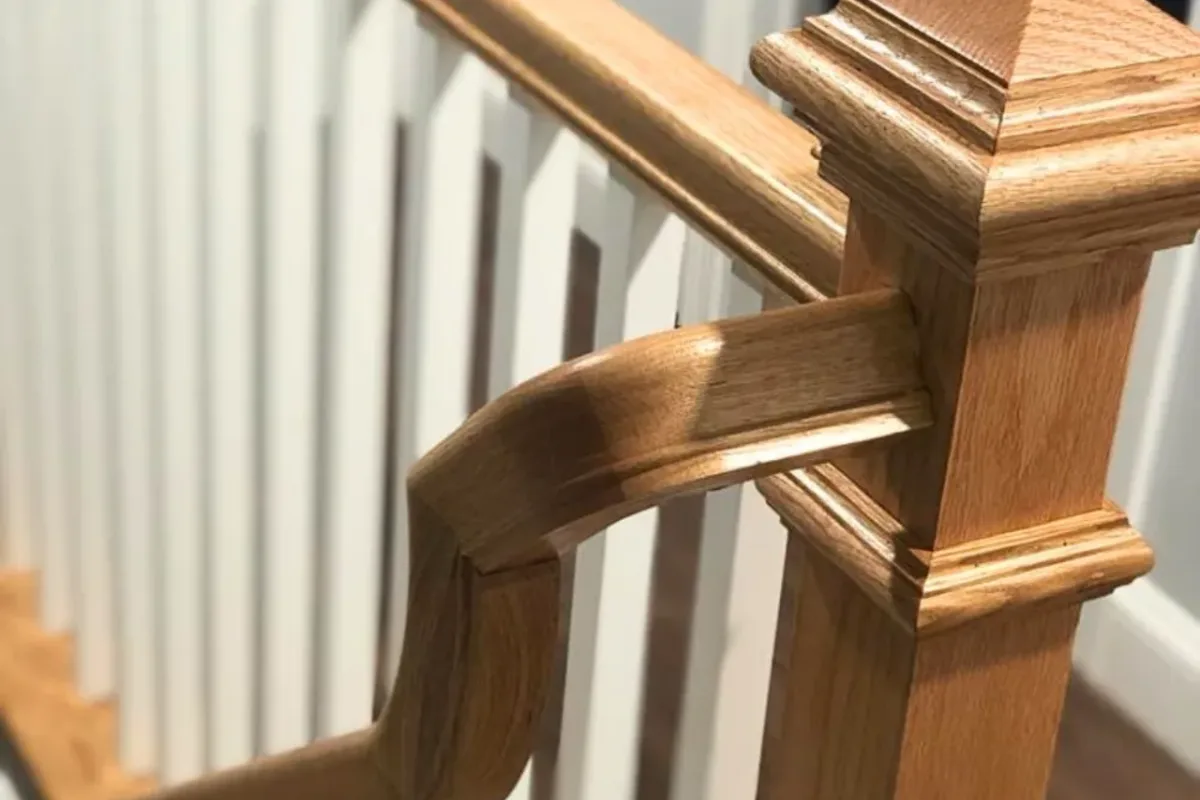
A few minutes of vocabulary makes every conversation with your contractor clearer, so here are the parts of a staircase we will reference during your Woburn project. The treads are the horizontal steps you walk on, and the risers are the vertical faces between them. The stringers are the diagonal boards that carry the whole structure, hidden behind or beside the steps. The handrail is what you grip; the balusters (sometimes called spindles) are the vertical members below it; and the newel posts are the sturdy anchor posts at the top, bottom, and any turn. The nosing is the small overhang at the front edge of each tread. When we say a staircase needs new balusters and re-anchored newels but the treads can be refinished, that is the difference between a few thousand dollars and a full rebuild, so knowing the parts helps you follow the estimate.
Basement and open stairs in Woburn homes
Many Woburn ranches, splits, and older homes have a basement staircase that was never finished to the same standard as the main flight, bare pine treads, an open side with no guard, or a wobbly single handrail bolted to the wall. When homeowners finish a basement into a family room, office, or gym, those stairs suddenly need to be safe and presentable. We add code-compliant guardrails on open sides, install a proper graspable handrail, cap or replace the treads, and improve the lighting at the top and bottom. Because basement stairs often sit in a damp environment, material choice matters here too, and we build accordingly.
Accessibility and aging-in-place stair upgrades
For Woburn homeowners planning to stay in their home for the long term, a stair remodel is a smart moment to build in accessibility. Continuous handrails on both sides, extra-graspable rail profiles, consistent riser heights, slip-resistant tread finishes, and improved stair lighting all make a staircase safer for older family members without making it look institutional. If a stair lift is a possibility down the road, we can plan tread and railing details that leave room for it. Thinking about this during the remodel, rather than retrofitting later, saves money and produces a cleaner result.
Staircase styles that suit Woburn homes
Because Woburn has such a broad range of architecture, there is no single right staircase style. The best remodels start from the house itself rather than a trend. Here is how we usually steer the design conversation with Woburn homeowners.
Traditional in Victorians and Colonials
The older homes near Montvale Avenue and the historic center often deserve a classic look: stained oak treads, painted risers, turned or paneled newel posts, and a warm hardwood handrail. When the house has original millwork, we match profiles and stain tones so the new staircase reads as though it always belonged there.
Transitional for the West Side and Four Corners
Many mid-sized Colonials and Capes look best with a transitional treatment: hardwood treads, white risers, and slim iron balusters. It keeps the warmth of wood underfoot while giving the railing a cleaner, updated line. This is the most popular request we get in Woburn because it modernizes without clashing with the rest of a traditional home.
Modern and open for ranches and renovated splits
Ranches and splits near Horn Pond and the newer developments can carry a more contemporary staircase: minimal balusters, a horizontal cable or thin iron look, and a bolder wood-to-metal contrast. In an open floor plan the staircase becomes a design element rather than a hidden passage.
Refinishing versus rebuilding: how we decide
One of the most valuable things we do on the first visit is tell a Woburn homeowner honestly whether their staircase can be saved with a refinish or genuinely needs to be rebuilt. Spending on a finish over a failing structure is money wasted, and rebuilding a perfectly good staircase is money you never needed to spend.
| Situation | Usually refinish or re-rail | Usually rebuild |
|---|---|---|
| Treads | Solid hardwood, worn finish only | Particleboard, split, or pulling loose |
| Stringers and framing | Sound and level | Rotted, cracked, or sagging |
| Rise and run | Meets code, comfortable | Uneven risers or non-compliant geometry |
| Railing | Repairable, right height | Undersized, non-compliant, or unsafe |
| Layout | Staying the same | Changing during a larger remodel |
We put this in writing in the estimate so there is no ambiguity. If a refinish will genuinely last, we say so, and if we are recommending a rebuild we explain exactly which conditions drove that call.
Silencing a squeaky Woburn staircase
Squeaks are the number one stair complaint we hear in older Woburn homes, and they almost always come from movement: a tread rubbing against a riser, a loose wedge under a tread, or a gap that opened as the framing dried out over decades. If we can access the underside of the stairs, we re-glue and re-shim the joints, add blocking, and screw treads down from below so the fix is invisible. When the underside is closed off, we address squeaks from above during the tread work. Refinishing alone will not silence a staircase, so if quiet stairs matter to you, tell us at the walkthrough and we will build the fix into the plan.
Dust control and living with the project
Sanding treads is the messiest part of any stair remodel, and in an occupied Woburn home that dust matters. We seal off adjacent rooms with plastic, run dust extraction on our sanders, and clean the work area at the end of each day. Because the staircase is a shared path, we also talk through logistics before we start: which days the stairs are off-limits during finishing, whether we stage the work so one route stays open, and how to keep pets and kids clear of curing treads. Good planning here is the difference between a stressful week and a smooth one.
Stairs as part of a larger Woburn renovation
A stair remodel rarely happens in a vacuum. Often it is triggered by a bigger project: a kitchen remodel that opened up a wall, a basement finish that needs a proper railing, or a whole-home refresh where the dated staircase suddenly stands out. As a full general contractor, we can fold the stairs into the larger scope so the finishes match, the schedule is coordinated, and you are dealing with one accountable team instead of three separate trades. If you are already planning kitchen work in Woburn or need a general contractor for a broader project, the staircase is easy to bring into the same plan.
Seasonal timing for stair work in New England
Interior stair remodels can happen year-round, but a few seasonal realities are worth knowing in Woburn. In the dead of winter, dry heated air actually helps finishes cure predictably, though very cold days can slow delivery of materials. In humid mid-summer, we watch cure times more carefully because high humidity can affect how stain and polyurethane set. Exterior and basement bulkhead stairs are best rebuilt in the milder shoulder seasons, spring and fall, when freeze-thaw is not fighting the concrete and fasteners. We plan around the calendar so the finish comes out right the first time.
Stain colors and finishes that hold up on treads
Color choice is where a lot of Woburn homeowners get stuck, so we bring samples and test them on your actual treads, because the same stain reads differently on red oak than on white oak, and differently again under your home's lighting. Warm mid-browns and classic golden oak tones suit traditional homes; cooler greige and dark espresso tones suit transitional and modern spaces; and a natural or whitewashed finish leans contemporary. Just as important as color is the topcoat: stairs take far more abuse than a floor, so we use a durable, appropriately rated polyurethane and build up enough coats to protect the high-traffic nosing. Matching your new treads to an adjacent hardwood floor is common, and we test the match before committing.
Matching new stairs to existing floors and trim
In an open Woburn entry, the staircase sits right next to the first-floor flooring and trim, so a mismatched stain or profile jumps out. When we refinish or replace treads, we sample against your existing hardwood so the tones blend, and we can match riser paint to your baseboard white and handrail profiles to your existing millwork. If your floors are being refinished at the same time, doing the stairs in the same pass lets us dial in one consistent color across the whole level. Small details like consistent nosing profiles and matched sheen are what separate a professional job from an obvious patch.
Questions to ask any stair contractor before signing
- Are you a registered Home Improvement Contractor, and can you share your HIC number and insurance certificate?
- Will your own crew do the work, or will it be subcontracted out?
- Does my project need a Woburn permit, and will you pull it and handle inspections?
- How will you handle any hidden structural issues you find once the carpet or finish comes off?
- What finish are you using on the treads, and how many coats?
- How many days will the stairs be unusable during finishing, and how will we get around?
- How do you protect the rest of the house from sanding dust?
A good contractor will answer all of these without hesitation. If any answer is vague, especially around licensing, permits, or who is actually doing the work, treat it as a warning sign.
Warranty, quality, and standing behind the work
Every staircase we build is meant to be quiet, solid, and code-compliant for the long haul, and we stand behind the workmanship. Because we run our own in-house crew, accountability is simple: there is no finger-pointing between subcontractors, and the same team that built your stairs is the team that answers if something needs attention. Combined with permitted, inspected work on any structural project, that gives Woburn homeowners real peace of mind, not just a handshake.
Other Woburn projects our crew handles under the same permit know-how: deck builders in Woburn, MA, home additions in Woburn, MA and built-in cabinets in Woburn, MA.
Why Woburn homeowners choose Innov Builders
Innov Builders is a licensed and insured general contractor based at 50 New Salem St in Wakefield, minutes from Woburn, led by Iago Maciel and staffed by an in-house crew rather than rotating subcontractors. We are OSHA certified and hold HIC #212869, and we treat stairs as the safety-critical, high-visibility feature they are, not as an afterthought at the end of a bigger job. From a single-day refinish to a full code-compliant rebuild with a new iron railing, we build stairs to Massachusetts code, pull the permits through the Woburn Building Department when the work requires it, and stand behind the result. If your Woburn staircase is squeaking, wobbling, or simply stuck in a past decade, we would be glad to take a look and give you an honest plan.
To get started, reach out for a free estimate. We serve Woburn along with Wakefield, Reading, North Reading, Lynnfield, Stoneham, Melrose, Winchester, Medford, Malden, and Saugus, and we are happy to walk your staircase, talk through the options, and put together a clear, itemized plan with no pressure.