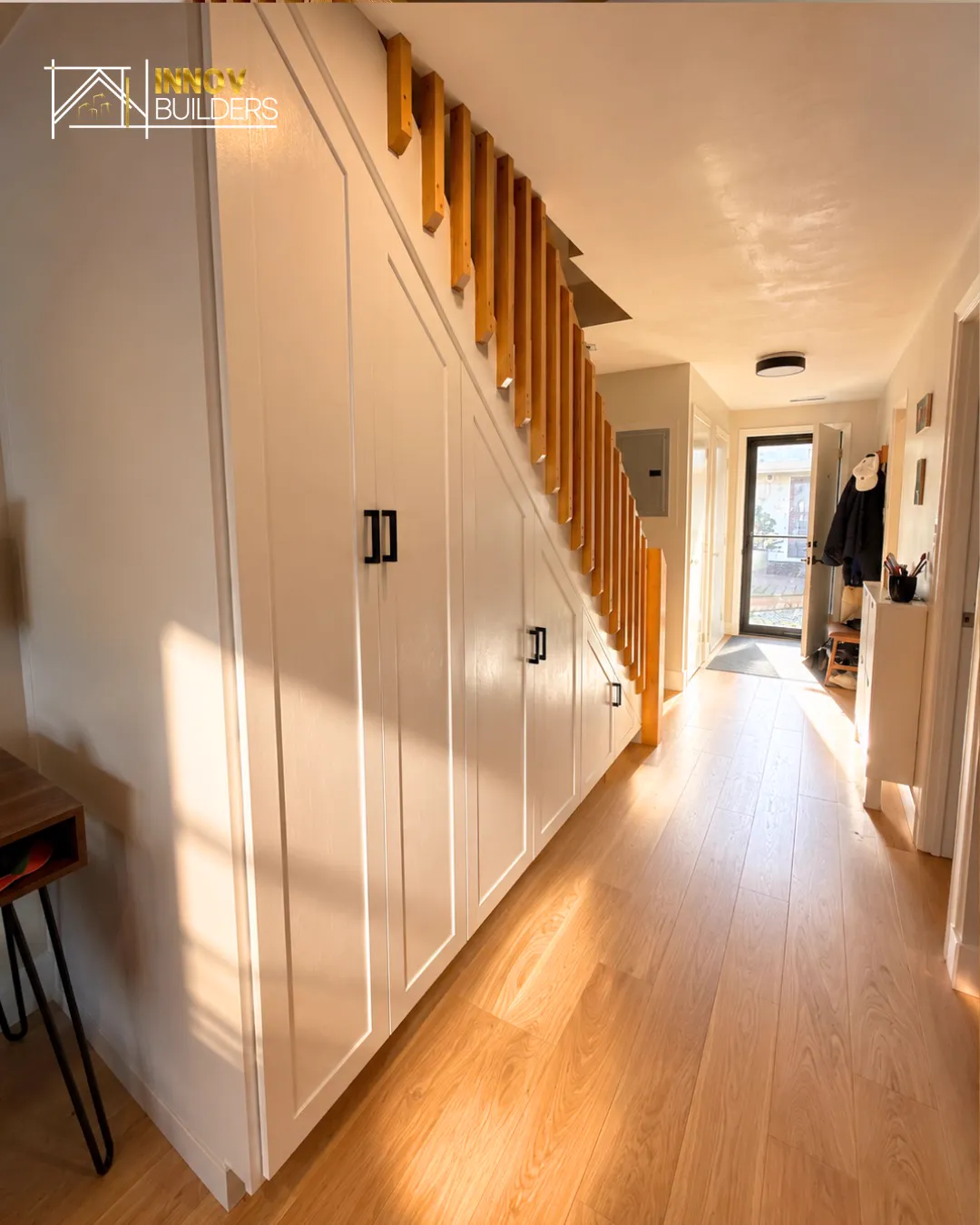
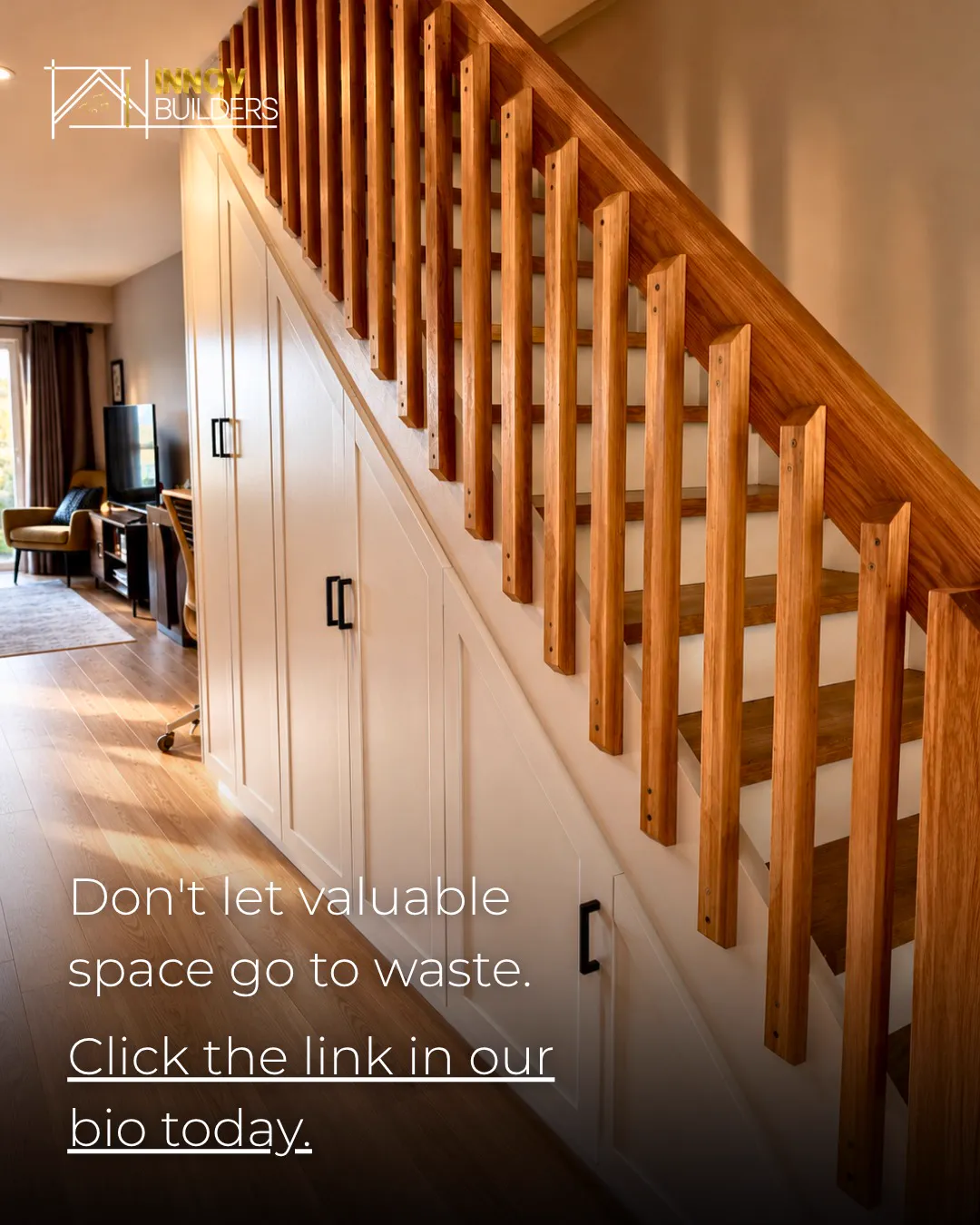
Innov Builders makes built-in cabinets Reading, MA families use every day, from under-stair storage in a 1950s cape to a pair of fireplace cabinets in an 1890s Queen Anne, and we build and install every piece with our own crew. Tell us which room and which wall, and we come to your Reading home for a free visit, measure it, and send a written, itemized estimate. Call (978) 788-1690 or use our contact form to book the visit. We are licensed and insured (HIC #212869), OSHA certified, and our shop is at 50 New Salem St in Wakefield, the next town over.
Most people searching for custom built-ins in Reading already know what they want to store. What they are less sure about is whether a carpenter can make new cabinetry look like it came with the house, whether the town needs to sign off on anything, and what a realistic price looks like. This page answers those three questions for Reading specifically: its mix of house ages, its two local historic districts, the Building Division on Lowell Street, and the Massachusetts contract rules that protect you when you hire someone for the job.
Custom built-ins in Reading, MA: what we make and who makes it
A custom built-in is cabinetry designed for one wall in one house. The boxes, shelves, doors and trim are sized to your room, set level against floors that are rarely level, and finished so the new work reads as part of the house instead of a piece of furniture pushed into a corner. In Reading we are asked most often for these pieces:
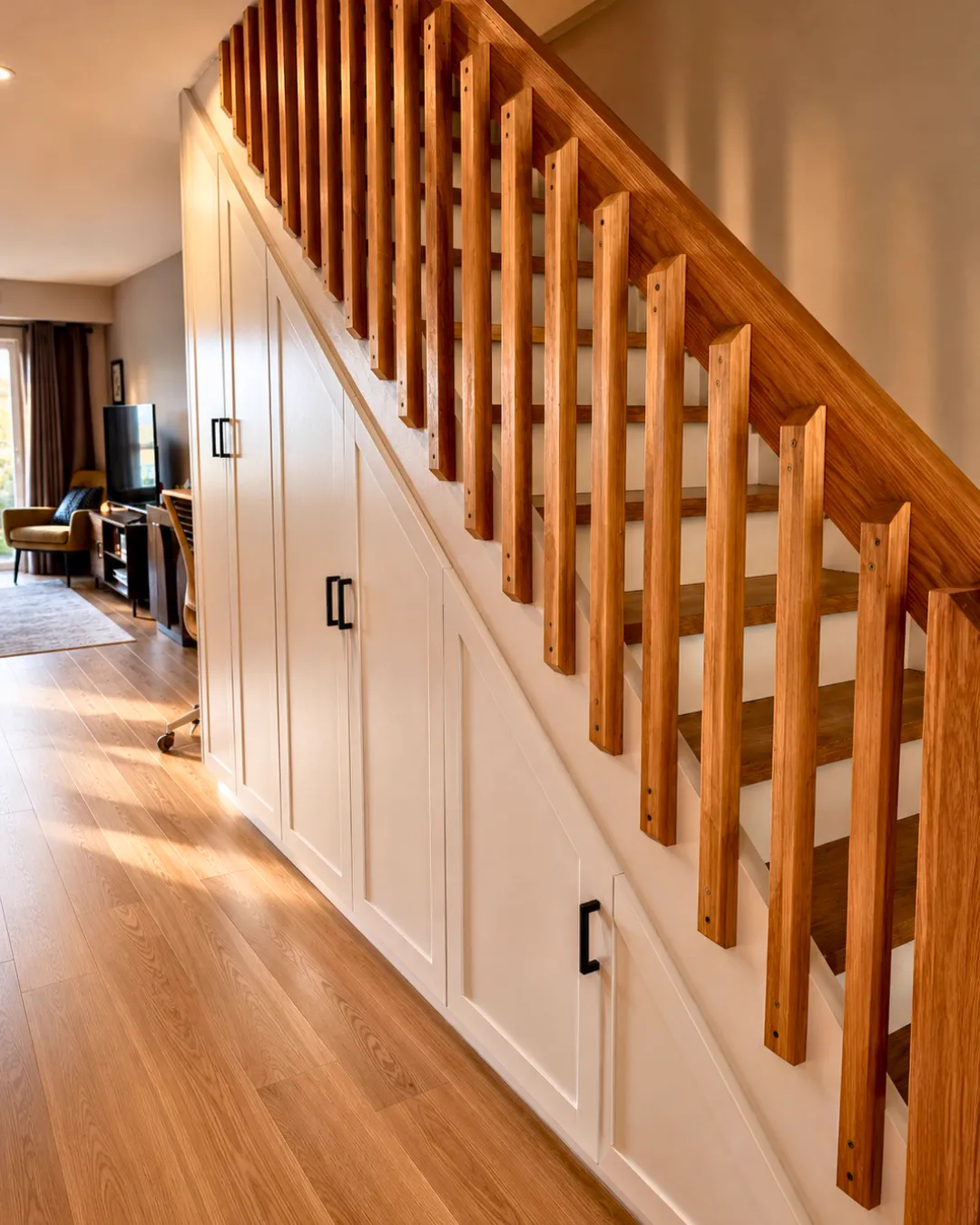
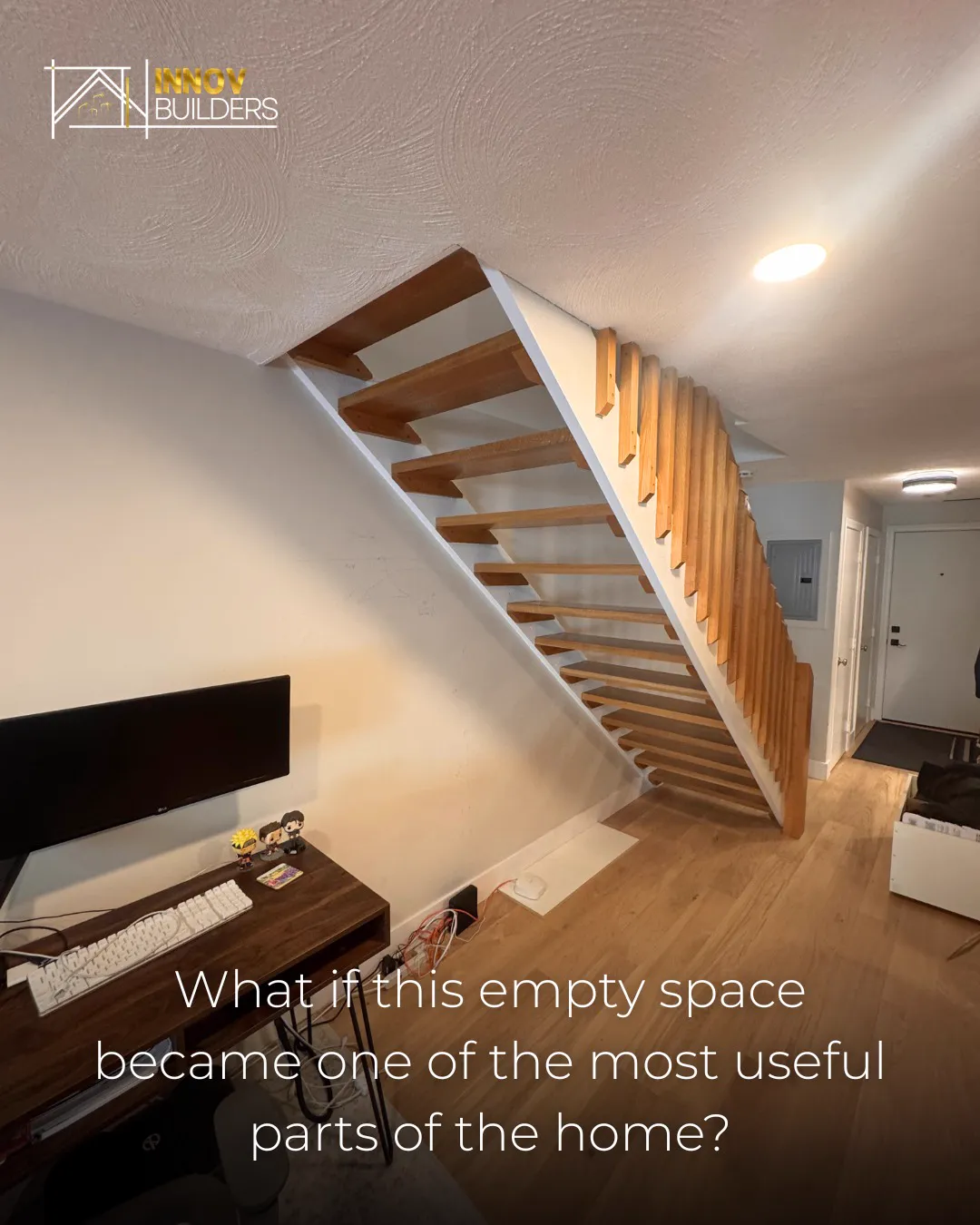
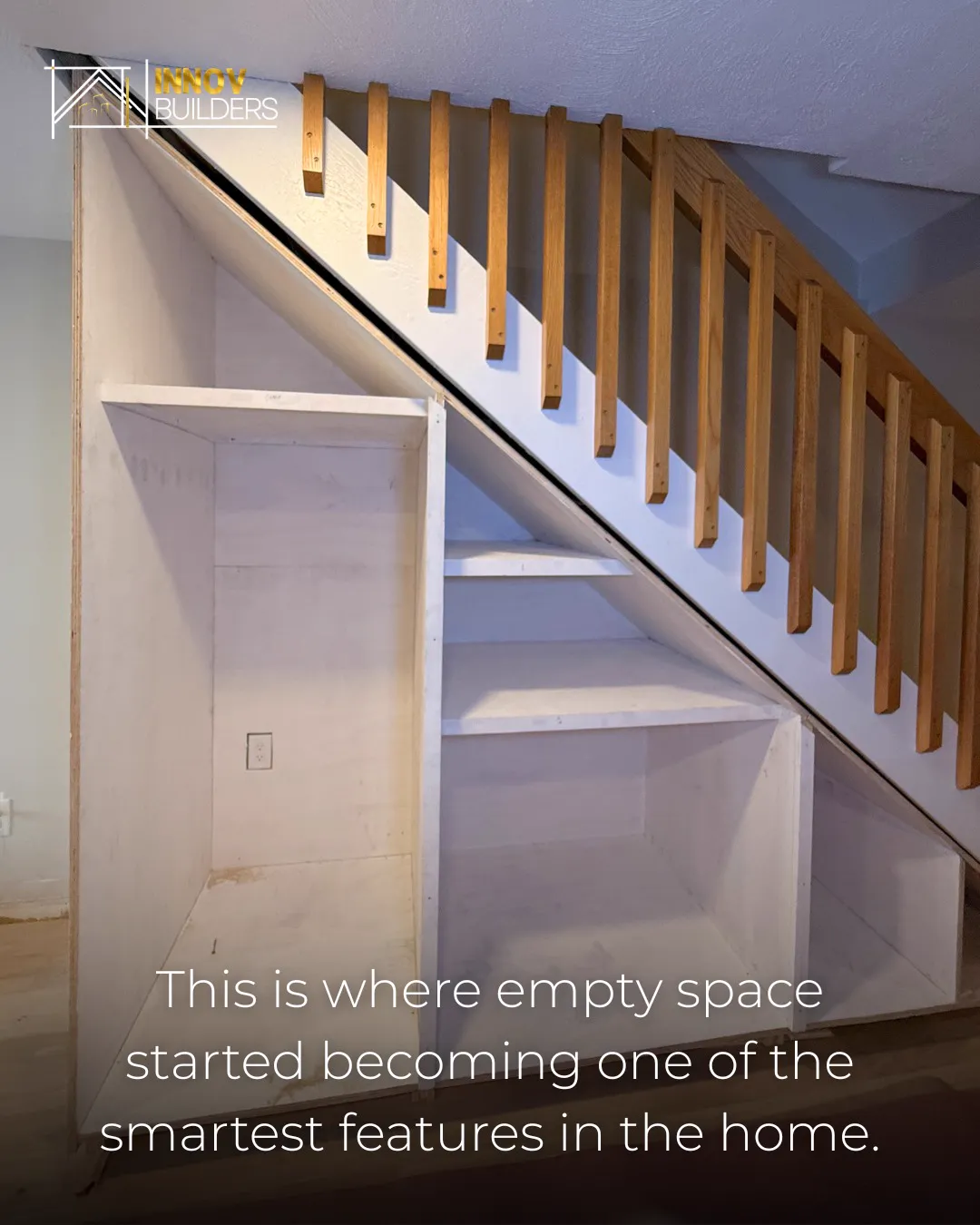
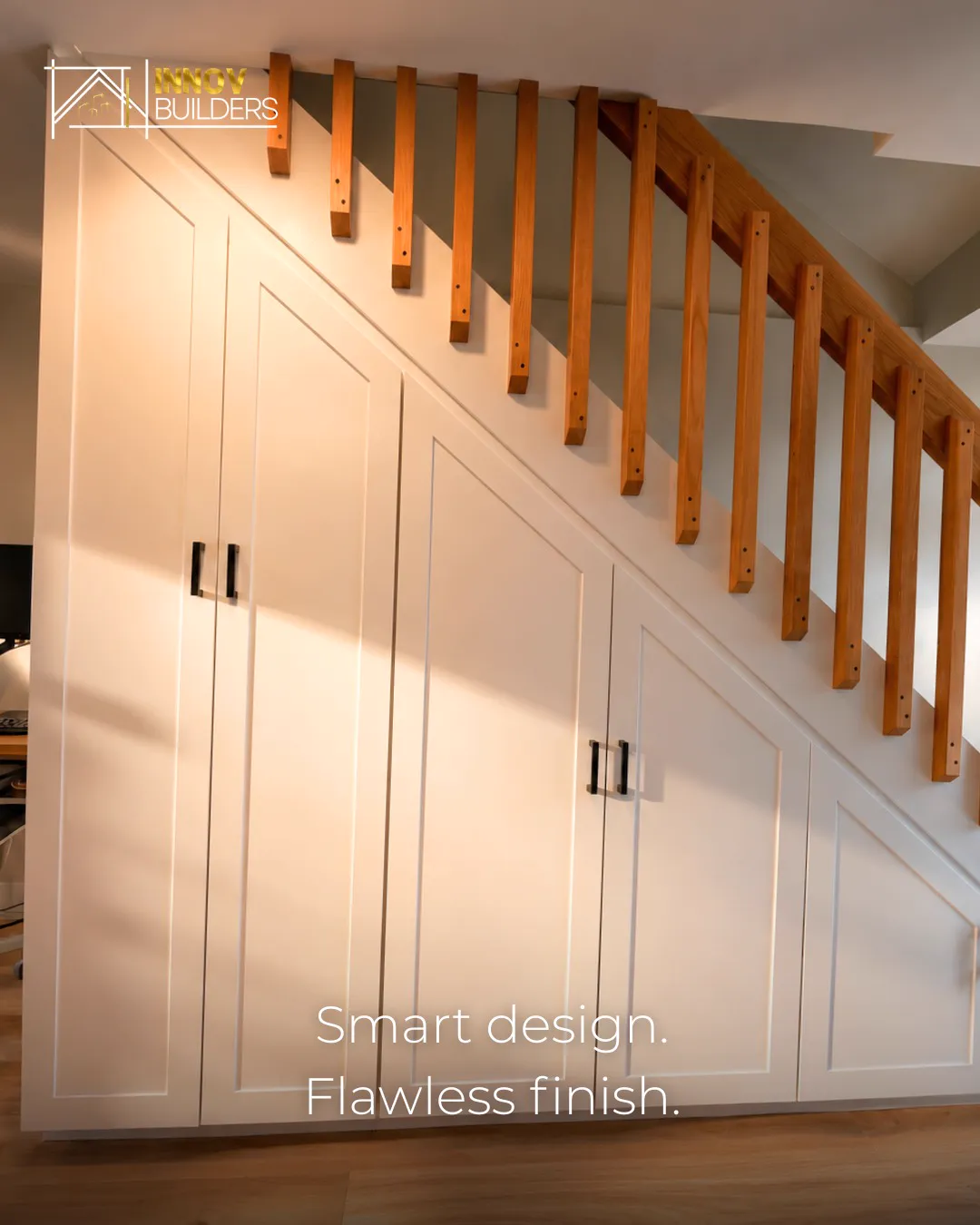
- Cabinets and drawers under a staircase
- Knee wall drawers and cabinets on the second floor of a cape
- Paired cabinets and shelves on each side of a fireplace
- Laundry counters with shelving above the washer and dryer
- Mudroom benches, cubbies and coat lockers by the side or garage door
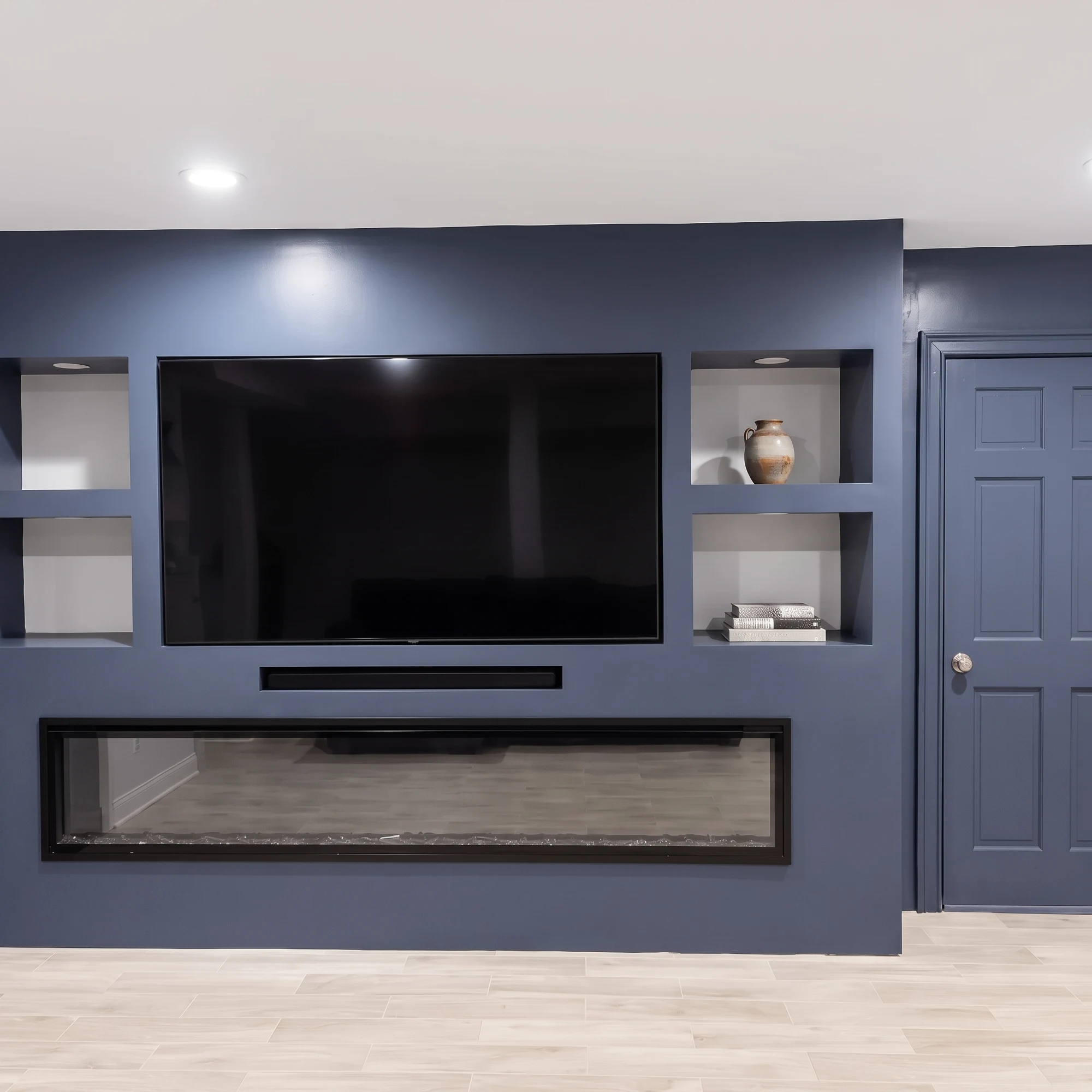
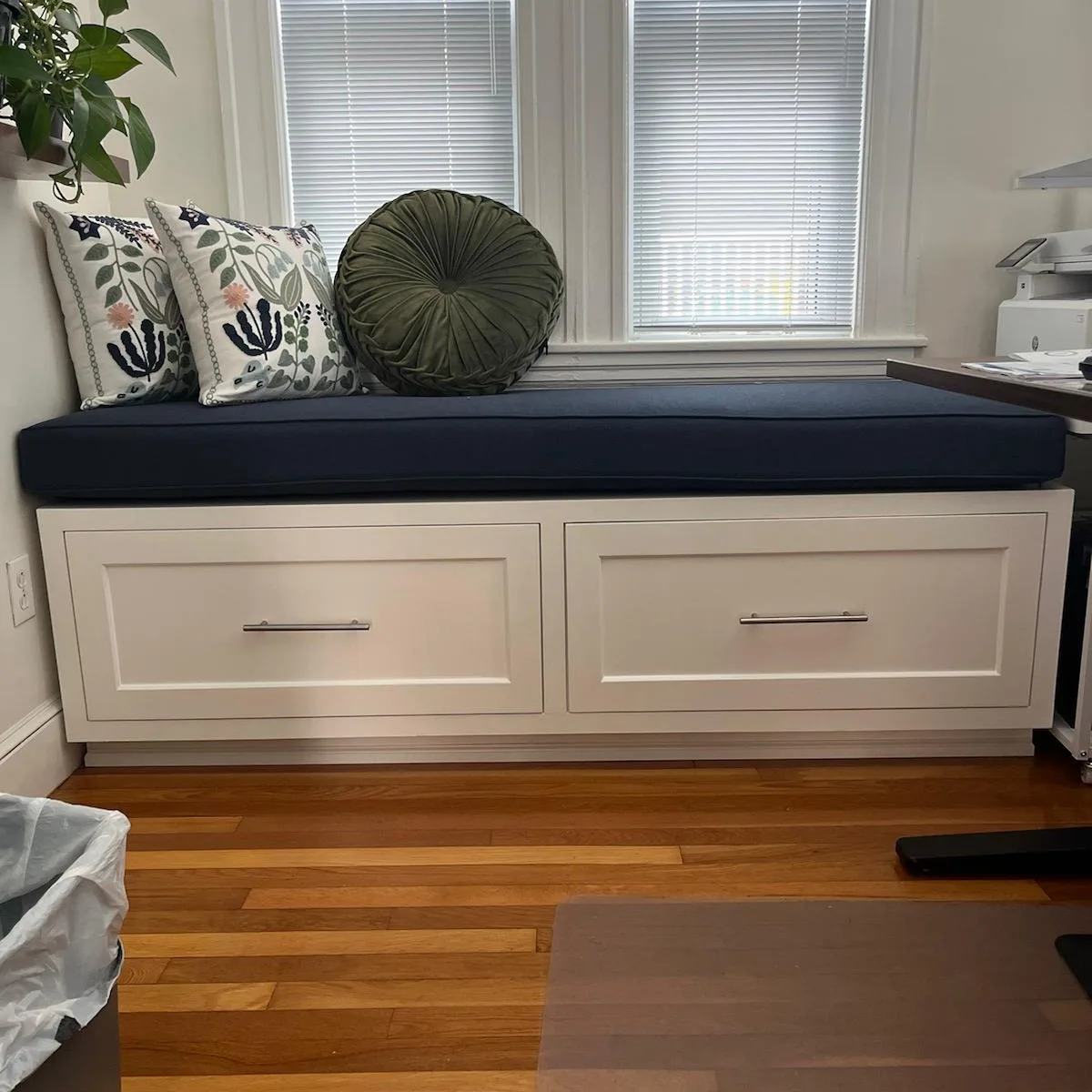
- Library walls, window seats, home office walls and media walls
- Basement bars and family room storage
The people who measure your room are the same people who build and install the cabinets. We do not sell the job and hand it to an outside cabinet shop. That matters in Reading because so much of the housing is old enough that the drawing never matches the room exactly, and somebody has to make judgment calls at the wall. When that person is on our crew, the call gets made the way we promised it would be. You can see the wider range of our finish carpentry on our custom cabinets and built-ins page.
Three generations of Reading houses, three different built-in problems
Reading is not a single kind of house. Housing data compiled by NeighborhoodScout puts roughly 27 percent of homes in town before 1940, about 37 percent between 1940 and 1969, around 21 percent from 1970 to 1999 and about 15 percent after 2000. Single-family detached homes are about 71 percent of the housing. Each of those eras hands a carpenter a different set of walls, and a good built-in plan starts with knowing which one you live in.
Before 1940: Federal cottages, Victorians and Colonial Revival homes
The oldest layer of Reading is still easy to find. The Parker Tavern at 103 Washington Street dates to 1694 and is the town's best-preserved central-chimney saltbox. The Batchelder House on Pearl Street is a Federal-period home from about 1783. The house at 483 Summer Avenue is a Federal cottage from around 1830, and 206 West Street is an 1831 Greek Revival cottage. The Woburn Street Historic District, listed on the National Register, holds sixteen houses that are mostly Colonial Revival and Queen Anne, with Greek Revival, Italianate, Shingle style and one Craftsman home mixed in.
In houses like these, the walls are usually plaster on wood lath, the floors have settled over a century or more, and the trim was often built up from several moldings rather than bought as one piece. Built-ins here succeed or fail on fit and on trim. A box that is square to itself will not sit tight to a wall that has leaned for a hundred years.
1940 to 1969: capes, ranches and garrison colonials
This is the largest share of Reading's houses, and it is where we find the most wasted space. Capes built after the war have second floors tucked under the roof, with knee walls that hide deep, empty triangles behind them. Ranches have long hallways, small bedrooms and a basement stair that often runs down from the kitchen. Garrison colonials have a center stair with an open cavity underneath. Walls may be plaster, early drywall or rock lath, and trim is simpler, which makes matching easier but also means a clumsy built-in stands out quickly.
1970 and later: splits, newer colonials and condos
Split-levels and raised ranches bring half-flights of stairs, lower-level family rooms and entries that open straight onto a landing with no closet worth the name. Newer colonials have larger rooms and straighter drywall, so the challenge shifts from fit to proportion: a built-in in a room with a two-story ceiling or a big open plan needs enough scale to hold the wall. In Reading's condominium buildings, the job starts with the association rules for work hours, deliveries and elevator or hallway protection.
A quick map of built-in opportunities by Reading house era
Use this table to match your house to the built-ins that usually pay off there and the fitting issue we plan around. It is a starting point, not a rule. Plenty of Reading homes were remodeled in ways that mix the eras.
| House era in Reading | Where built-ins usually go | Fitting issue we plan for | How we handle it |
|---|---|---|---|
| Before 1940 (Federal, Greek Revival, Victorian, Colonial Revival) | Fireplace walls, parlor bookcases, window seats in bays, butler's pantry style cabinets | Leaning plaster walls, sloped floors, built-up period trim | Scribed sides and tops, profiles built up to match, cabinets set on a leveled base |
| 1940 to 1969 (cape, ranch, garrison) | Under the stairs, knee walls, hallway linen cabinets, basement stair walls | Hidden ducts, wiring and insulation behind knee walls and under stairs | Open and inspect the cavity first, keep insulation and air sealing continuous |
| 1970 to 1999 (split-level, raised ranch) | Entry landings, lower-level family rooms, laundry areas | Short walls broken by half-flights and doors | Shallow cabinets, benches that fit a landing, storage stacked vertically |
| 2000 and later (newer colonials, condos) | Media walls, home offices, mudrooms off the garage | Large, open rooms that dwarf small units, association rules in condos | Full-height designs with crown, early paperwork with the condo board |
Under the stairs: the most wasted space in a Reading house
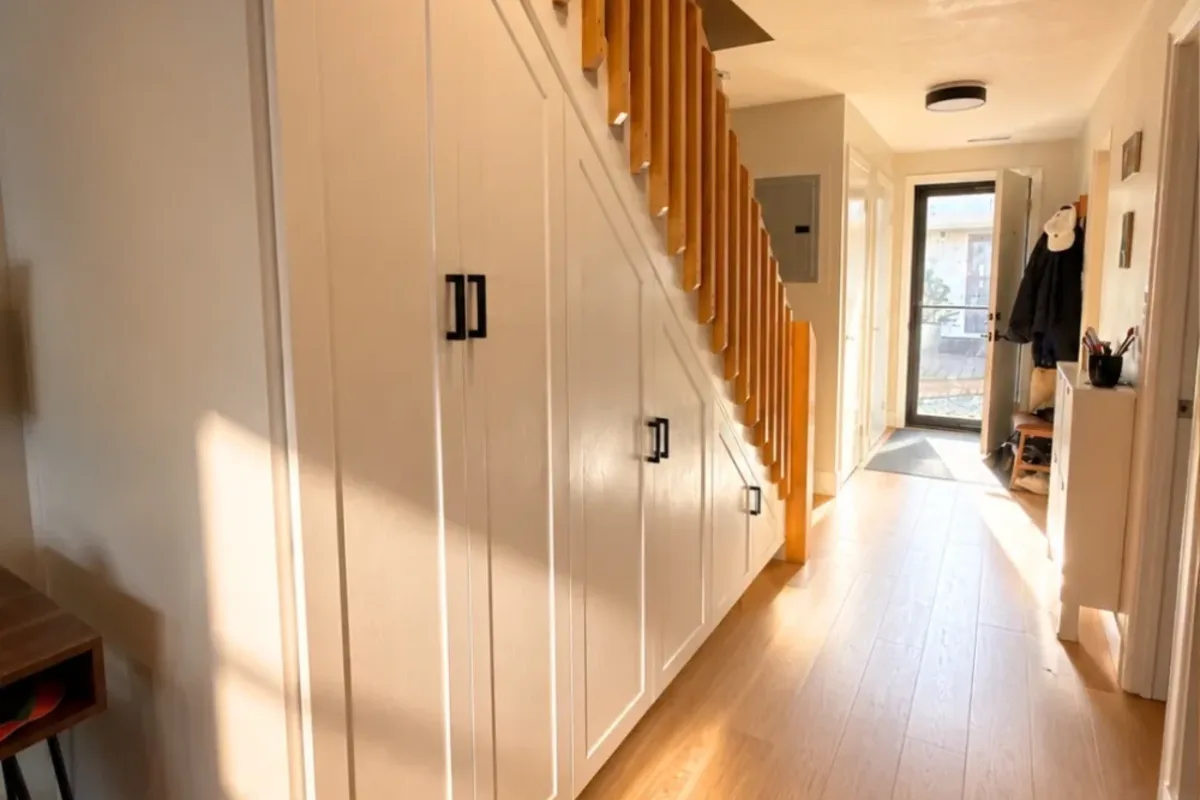
A center-hall garrison or a colonial with a straight stair usually has a triangle of dead space under it that is taller than most closets. In many Reading homes that space is a dark closet with one door, a vacuum and a pile of boots. Turned into a run of cabinets with doors or pull-out drawers that follow the slope of the stair, it becomes one of the most useful pieces of storage in the house.
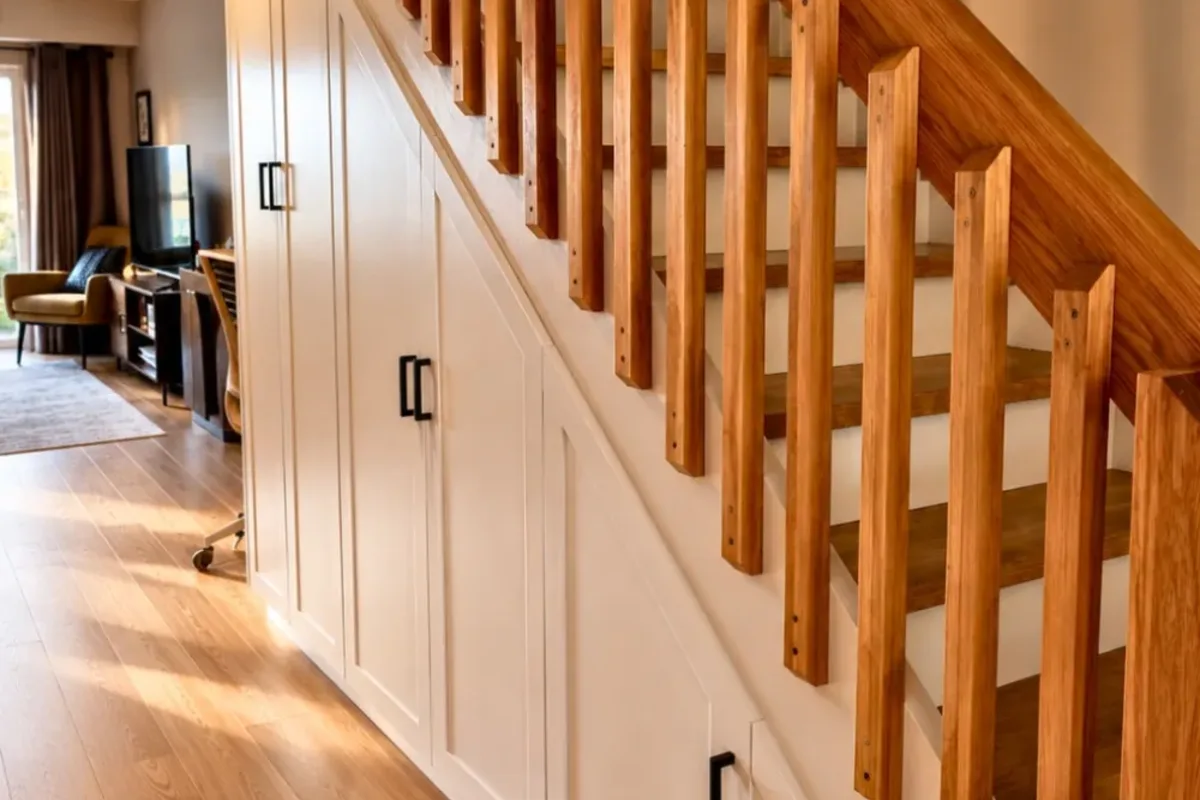
Before we draw anything, we open the space and look. Under-stair cavities in Reading houses often carry a heating duct, a gas line, a junction box or the cleanout for a drain, and the stair stringers need to stay structurally untouched. Once we know what is in there, we lay out the doors so each opening lines up with something useful: tall doors at the high end for coats or a vacuum, drawers or shorter doors at the low end. If you are also thinking about the stair itself, new treads or a railing that meets code, our stair remodeling work in Reading can be planned together with the cabinets so the two jobs share trim and paint.
Knee walls in Reading capes: storage hiding behind the drywall
If you live in one of the many capes Reading built between the 1940s and 1960s, the upstairs bedrooms probably have short walls about three or four feet high, with the roof sloping above them. Behind those walls is an unfinished triangle that runs the length of the house. Built-in drawers or cabinets set into the knee wall reclaim that space without taking an inch of floor.
The catch is that the knee wall is usually part of the house's insulated envelope. Cutting an opening without a plan can leave a cold hole into an unheated attic space, with drafts in winter and heat in summer. When we build into a knee wall, we frame a proper box for each unit, then insulate and air seal around it so the thermal boundary stays continuous. Drawers work better than doors here because they pull the contents out to you instead of asking you to crawl in after them.
Fireplace walls in older Reading homes
The central-chimney saltbox that survives at the Parker Tavern is the ancestor of a layout that shows up all over older Reading: a chimney mass in the middle of the house with a fireplace on one or more sides. In Victorian and Colonial Revival houses, the fireplace often sits on an outside wall with windows beside it. Either way, the alcoves on each side of the chimney are natural spots for a matched pair of cabinets with shelves above.
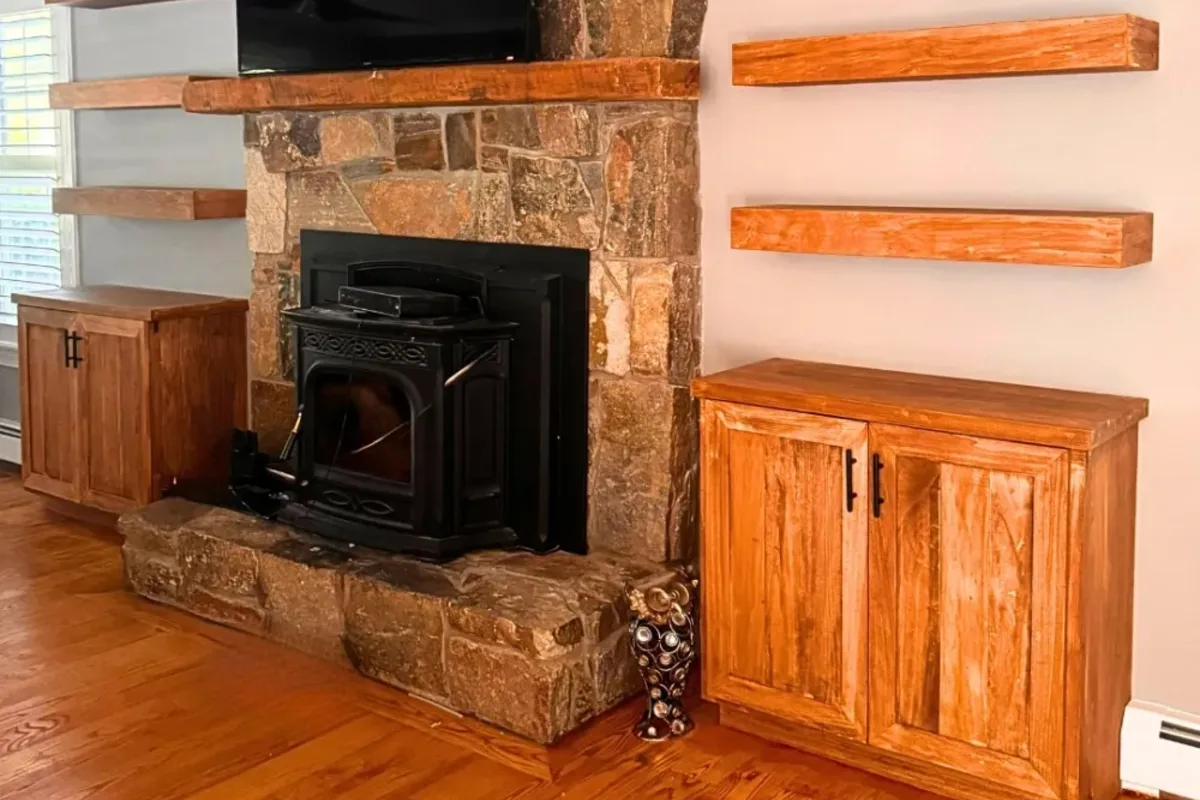
Two details matter here. First, the cabinets must respect the clearances around the fireplace opening, the hearth and any wood or pellet stove, so we confirm the manufacturer's requirements and the code before we set a single box. Second, the two sides of a chimney are almost never the same width in an old house. We measure both alcoves separately and adjust the cabinets so the pair looks symmetrical from the room even when the openings are not.
Laundry rooms and mudrooms for Reading's ranches and split-levels
In a lot of Reading ranches and split-levels, the laundry sits in the basement or a lower-level room with bare walls, and the family enters through a side or garage door with nowhere to put anything. Both spots respond well to simple, sturdy built-ins.
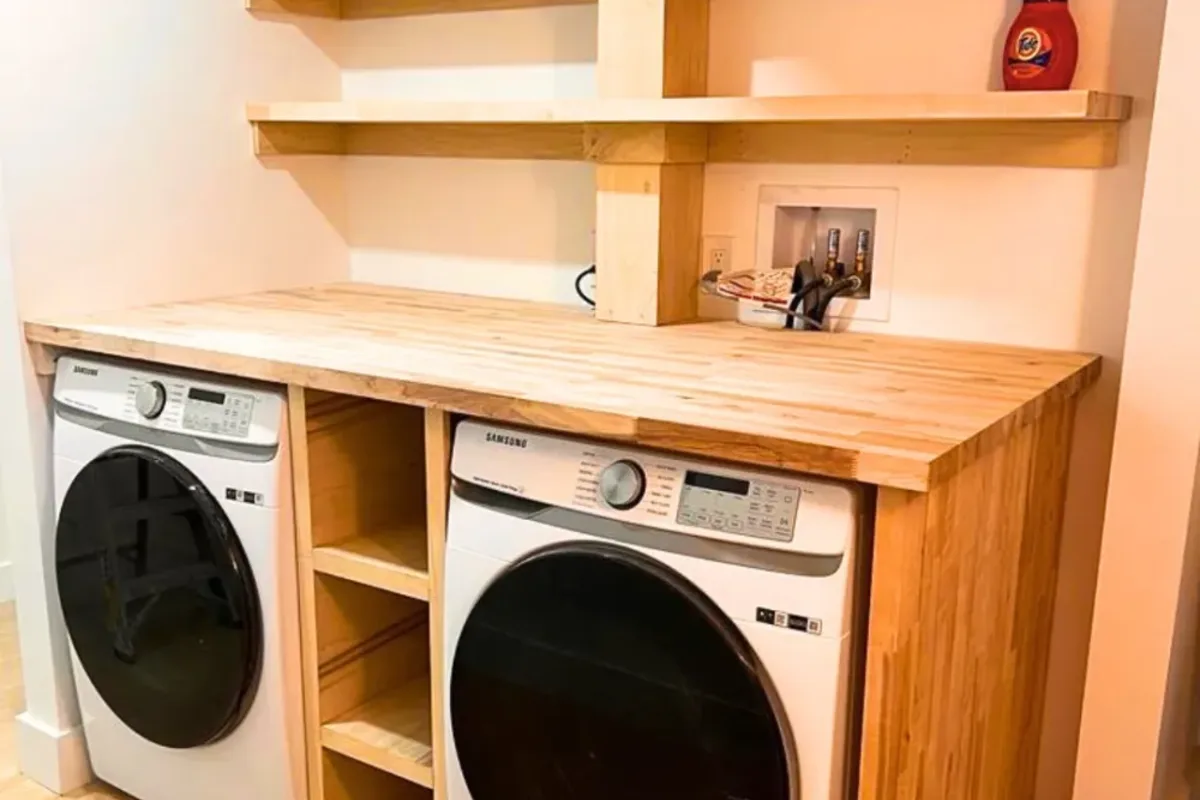
A folding counter over front-load machines, with open shelving above and a narrow cubby between them, turns a basement corner into a work area. We leave access to the water valves and the dryer vent, and we set the counter height so the machines can still be pulled out for service. By the door, a bench with cubbies, hooks and a closed cabinet above keeps the winter gear in one place. In a split-level, where the entry lands on a stair, we often build a shallow bench and hooks on the landing wall rather than forcing a deep locker into a tight space.
Library walls, window seats, bars and media walls
The larger feature pieces are where built-ins become the focal point of a room. Our finished built-in work across Massachusetts includes a media wall in Newton, a window bench in Quincy, a bar in Sherborn and built-ins in Beverly, Brookline, Salem and Harvard. Photos are on our project portfolio. In Reading, these pieces tend to land in particular rooms:
- Library walls in the front parlor or living room of an older house, where ceilings are taller and the room was built for display.
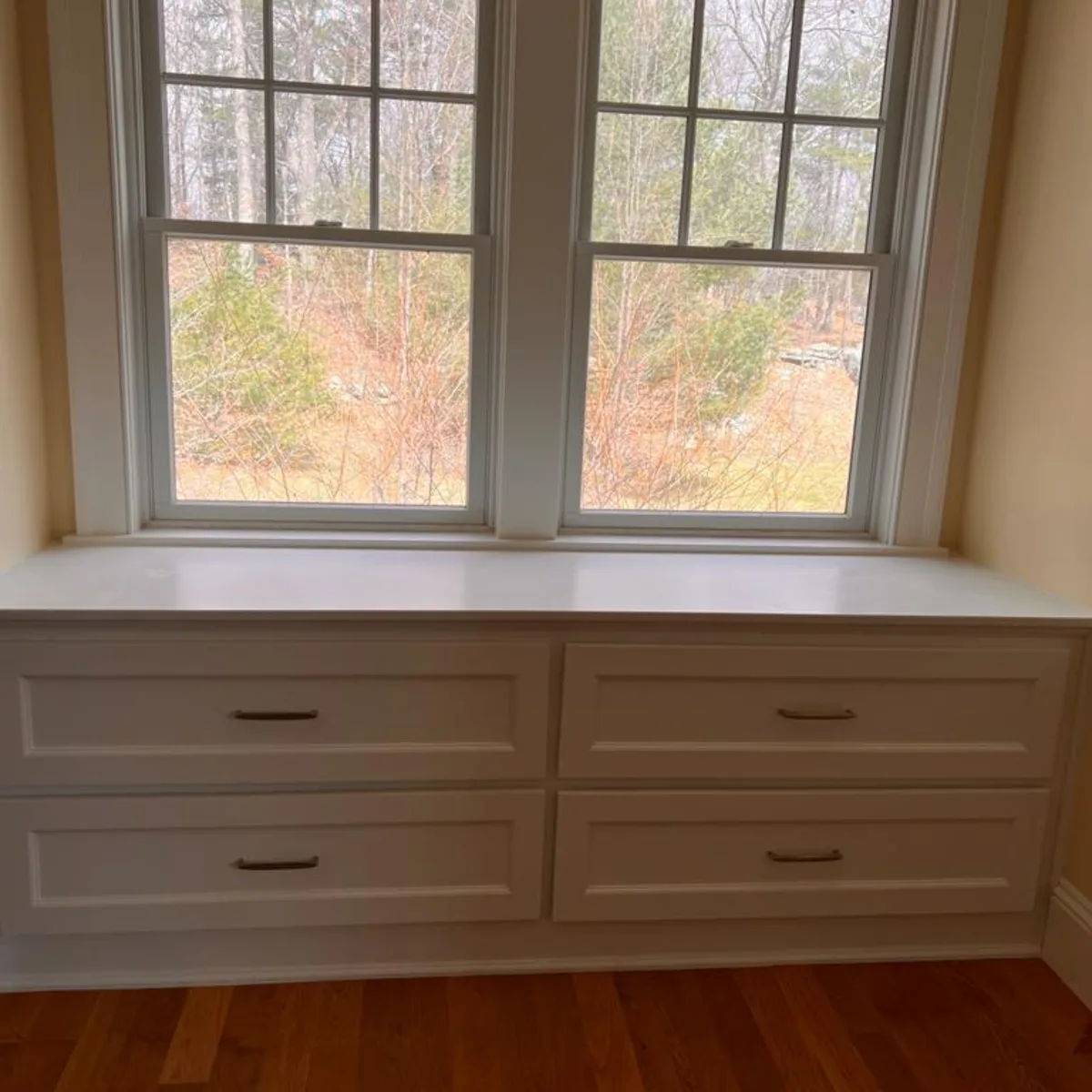
- Window seats in bay windows on Victorian and Colonial Revival homes, with drawers or a lift lid below.
- Bars in finished basements, often combined with a family room. If a sink is involved, plumbing comes into the plan. Our basement remodeling in Reading page covers the rest of the lower level.
- Media walls in newer family rooms, with closed storage for equipment, space for air to move and a plan for the wiring before the drywall is closed.
Have a wall like one of these in mind? Call us at (978) 788-1690 or request a free estimate, and send a few photos of the room ahead of time. We will come to Reading with ideas already sketched.
Matching trim that is 60 or 160 years old
The fastest way to spot a built-in that was added later is the trim. New crown that does not line up with the old crown, a baseboard that is an inch shorter than the one beside it, or a modern door style next to century-old casings all give it away. Our approach in Reading homes:
- Read the room's trim first. We note the height and profile of the baseboard, the casing around doors and windows, and any crown or picture rail.
- Find or build the profile. When a stock molding matches, we use it. When it does not, we build the profile up from two or three moldings so the shadow lines fall in the same places.
- Carry the lines through. The built-in's base runs at the same height as the room's base, and its crown meets the ceiling molding instead of stopping short of it.
- Match the finish. Painted trim gets a paint match. In houses with stained woodwork, we pick the species and test stain samples on the actual wood before we commit.
Mid-century Reading homes are simpler, often with flat or lightly shaped casings. The same rule applies: the built-in should use the house's own vocabulary, even when that vocabulary is plain.
Reading's historic districts: what the Commission reviews and what it does not
Reading has two local historic districts, the West Street Historic District and the Summer Avenue Historic District, which was established in 2015. Both are overseen by a five-member Historic District Commission. The Commission's design guidelines focus on exterior architectural features that can be seen from a public way. Interior work, including new cabinetry, is not what it reviews.
Where a built-in project can cross into the Commission's territory is on the outside wall. The guidelines put new windows, doors or other openings in exterior walls under review. If your plan includes enlarging a window for a window seat, adding a bay or cutting a new opening for light in a library, that part needs the Commission's attention before work starts. We flag it at the design stage, so the inside plan and the outside approval move together.
Note that the Woburn Street Historic District mentioned above is a National Register listing. National Register status on its own does not create the same local review that West Street and Summer Avenue have. If you are not sure which applies to your address, the Town publishes property lists and maps for its historic districts, and we can check it with you.
Wiring a built-in in Reading: the Building Division on Lowell Street
Most built-ins become more useful with power: lights inside a library wall, an outlet in a desk, a charging drawer or a TV connection. In Reading, permits for building, electrical, plumbing and gas work all run through the Building Division at 16 Lowell Street, and applications are filed through the Town's online portal on ViewPoint Cloud. New wiring is done by a licensed electrician, who pulls the electrical permit.
A few local details help with scheduling. According to the Town's inspector hours page, the electrical inspector takes calls Monday through Thursday from 7 to 8 a.m., and there are no electrical, plumbing or gas inspections on Fridays. The electrical permit has to be issued before an inspection can be scheduled. Because the rough wiring needs to be inspected before it is covered, we build the schedule so the inspection lands before the cabinet backs and panels close up the wall, rather than having to pull finished work apart.
Your electric service in Reading comes from the Reading Municipal Light Department (RMLD), the town-owned utility that also serves North Reading, Wilmington and Lynnfield Center. A built-in lighting circuit is almost always handled inside the house, under the Town's permit, without any work on the utility side.
A permit checklist for built-in projects in Reading
Here is how we sort the permit question for a typical Reading built-in. We confirm every project with the Building Division before we start, and every permit the job needs is listed in our written estimate.
| What the project includes | Permit usually involved | Who handles it |
|---|---|---|
| Cabinets and shelves fastened to existing walls, no wiring | Usually no permit for the cabinetry itself | Innov Builders confirms with the Building Division |
| New lighting, outlets or a dedicated circuit | Electrical permit and inspection | Licensed electrician |
| Moving, opening or reframing a wall | Building permit | Innov Builders as licensed contractor |
| A sink in a bar or laundry built-in | Plumbing permit | Licensed plumber |
| Work near a gas fireplace insert or gas line | Gas permit if gas piping changes | Licensed gas fitter |
| New or enlarged exterior window in the West Street or Summer Avenue district | Historic District Commission review plus a building permit | Innov Builders prepares the application with you |
What built-in cabinets cost in Reading, MA
These ranges are estimates for installed custom work in Reading and nearby towns. They vary with size, material, finish, how many doors and drawers there are, how much fitting an old wall needs, and whether electrical or plumbing work is part of the job. After our visit you get an itemized number for your room.
| Built-in project | Estimated installed range | What moves it up |
|---|---|---|
| Under-stair cabinets or drawers | $3,500 to $9,000 | Pull-out drawers, angled doors, relocating a duct or wire |
| Knee wall drawers or cabinets (per wall) | $2,000 to $6,000 | Number of units, insulation and air sealing work |
| Pair of fireplace cabinets with shelves | $5,000 to $12,000 | Stain-grade wood, uneven alcoves, lighting |
| Laundry counter with shelving | $2,000 to $5,000 | Solid wood top, upper cabinets, sink |
| Mudroom bench, cubbies and lockers | $4,000 to $10,000 | Closed lockers, upper cabinets, paneled back |
| Window seat with storage | $2,500 to $6,000 | Drawers instead of a lift lid, curved or angled bays |
| Floor-to-ceiling library wall | $8,000 to $18,000 | Rolling ladder, glass doors, matching period crown |
| Media wall | $7,000 to $18,000 | Wiring, ventilation, stone or panel detail |
| Basement bar | $8,000 to $25,000 | Sink and plumbing, beverage fridge, counters |
Where the money goes in a built-in quote
A built-in estimate has four parts, and knowing them makes it easier to compare contractors. Materials are the plywood, hardwood, moldings and hardware. Shop time covers cutting, assembling and preparing parts. Site time is installation, scribing and trim, and in older Reading houses this is often the largest line, because the fitting is where the hours go. Finishing is priming and painting or staining and sealing. Electrical, plumbing and permit costs sit on their own lines. If a quote shows one lump sum with no breakdown, ask for one. It is the only way to see whether two prices are for the same job.
Your built-in contract under Massachusetts law
Massachusetts regulates home improvement contracts under Chapter 142A of the General Laws. According to the state's guidance on Mass.gov, any home improvement contract over $1,000 must be in writing and signed before work begins. Among other items, it has to include the contractor's registration number, a detailed description of the work and materials, the start date and the date the work should be substantially complete, and the total price. It must also include a notice of your right to cancel within three business days, and the notice "Do not sign this contract if there are any blank spaces" printed directly above the signature line.
Our contracts for Reading built-ins list our HIC registration #212869, the rooms and pieces included, the materials by name, the finish, any permits and the schedule. If a contractor offers to skip the paperwork on a job of this size, treat that as a warning about how the rest of the project will go.
Want to see what a written estimate from us looks like? Book a free visit at (978) 788-1690 or through our contact page. You get the itemized quote whether or not you hire us.
A realistic schedule for a Reading built-in
Every project is a little different, but most follow the same order:
- Visit and measure. We walk the room, check the walls and floor with a level and a laser, and talk about what you want to store.
- Design and estimate. You get a drawing and an itemized estimate, with any permits noted.
- Permits and ordering. If wiring or plumbing is involved, permits are filed with the Building Division. Materials and hardware are ordered.
- Shop work. Boxes, doors, drawers and moldings are prepared.
- Rough work on site. Openings are framed, wiring is run and inspected before anything is covered.
- Install and fit. Cabinets go in level, sides and tops are scribed to the walls, and trim ties the piece into the room.
- Finish and walkthrough. Painting or staining, hardware, adjustments, cleanup, and a final walk with you.
A single window seat or knee wall can be a few days on site. A full library wall or a multi-piece mudroom is more often one to two weeks from install to final coat, with shop time ahead of that. Paint and stain drying time is real, especially in humid summer weeks, and we build it into the schedule instead of rushing the last coat.
Materials for a Reading basement, a sunny bay and a dry winter
The right material depends on where the built-in lives. A basement bar or laundry counter faces more humidity than a second-floor bookcase, so we keep cabinet boxes off the concrete, use moisture-tolerant materials near the floor, and avoid raw particleboard entirely. A window seat in a south-facing bay gets direct sun that can fade stained wood, so paint or a UV-resistant finish often makes more sense there. Across all rooms, forced-air and radiator heat dry the house out in winter, and wood moves with it. We use plywood for boxes and shelves because it stays flat and holds screws, MDF for painted flat panels because it stays smooth, and solid hardwood for face frames and edges that take daily wear.
Built-in mistakes we find in Reading homes
When we are called to fix or replace a built-in in Reading, the problem is usually one of these:
- A cold-air return or duct covered by cabinetry. Common in mid-century ranches and capes, where a return grille sits low on an interior wall. Covering it makes the room uncomfortable and the heating system work harder.
- A knee wall opened with no insulation plan. The drawers feel cold, and the room gets drafty in January.
- Cabinets screwed into plaster instead of framing. Plaster and lath will not hold a loaded bookcase for long. Fasteners need to reach studs or proper blocking.
- A radiator boxed in with no airflow. The heat has nowhere to go, and the wood above it dries and cracks.
- Outlets and switches buried behind a new unit. Covered boxes are both a code problem and a service headache.
- Cabinets set to the floor instead of to level. In older houses the floor can drop noticeably across a room, and the doors end up out of line.
Each of these is avoidable with a careful look at the wall before the design is final.
Seven questions to ask before you hire someone for custom built-ins in Reading
- Is your Massachusetts HIC registration number on the contract, and can I see your certificate of insurance?
- Will the people who measure my room be the ones who install the cabinets?
- Can you show me built-in work you have finished, not only general remodeling photos?
- What will the cabinet boxes, shelves and doors be made of, by name?
- How will you match the trim in my house, and what happens if a stock profile does not match?
- Which permits does my project need in Reading, and who will pull them?
- Does the price include finishing, hardware, electrical work and cleanup, or are those extra?
Clear answers to all seven are a good sign. Vague answers on materials or permits are the most common red flag we hear about from homeowners who come to us after a bad experience.
How to get ready for the first visit
A little preparation makes the first visit more useful and the estimate more accurate:
- Clear enough space along the wall that we can measure it top to bottom.
- Collect a few photos of built-ins you like, even from magazines or social media.
- Make a rough list of what the built-in needs to hold: books, a TV and equipment, coats and boots, linens, bar glassware.
- Know roughly when your house was built, and whether it sits in the West Street or Summer Avenue historic district.
- If you live in a condo, have the association's rules on renovation work handy.
- Think about power: where you want lights, outlets or charging.
Built-ins alongside other work in your Reading home
Built-ins are often part of a bigger plan, and doing them in the same project saves repeat trim and paint work. A built-in pantry or banquette fits naturally into a kitchen remodel in Reading. Basement bars and family room storage go with finishing the lower level. Under-stair cabinets pair well with a stair update. And if you are adding space, our home additions in Reading, MA can be framed with built-in niches and window seats planned from the start, instead of fitted in later. One crew handles the carpentry across all of it, so the trim and finish match room to room.
A short drive to every Reading neighborhood
Reading shares its eastern town line with our home base, and Route 129 connects the two: it runs through Reading as Salem Street and reaches the town line at the I-95 and Route 128 rotary. That puts our shop at 50 New Salem St a short drive from most of Reading, whether you are near the Woburn Street district, on Summer Avenue or West Street, off Pearl Street, or close to Haven Street downtown. Short trips mean we can come back to check a wall, hang a door or touch up a finish without making it a scheduling ordeal.
We build built-ins in the surrounding towns too. See our pages for built-in cabinets in North Reading, MA, built-in cabinets in Woburn, MA and built-in cabinets in Wakefield, MA.
If your plans in Reading go further than one room, read our guides on deck builders in Reading, MA.
Get a free estimate for built-in cabinets in Reading, MA
Whether it is the empty space under your stairs, the knee walls in a cape bedroom or the alcoves beside an old fireplace, we can turn it into storage that looks like it was always there. Call Innov Builders at (978) 788-1690 or request your free estimate online. We will visit your Reading home, measure the room, talk through materials and trim, and send an itemized written estimate that lists every permit the project needs.