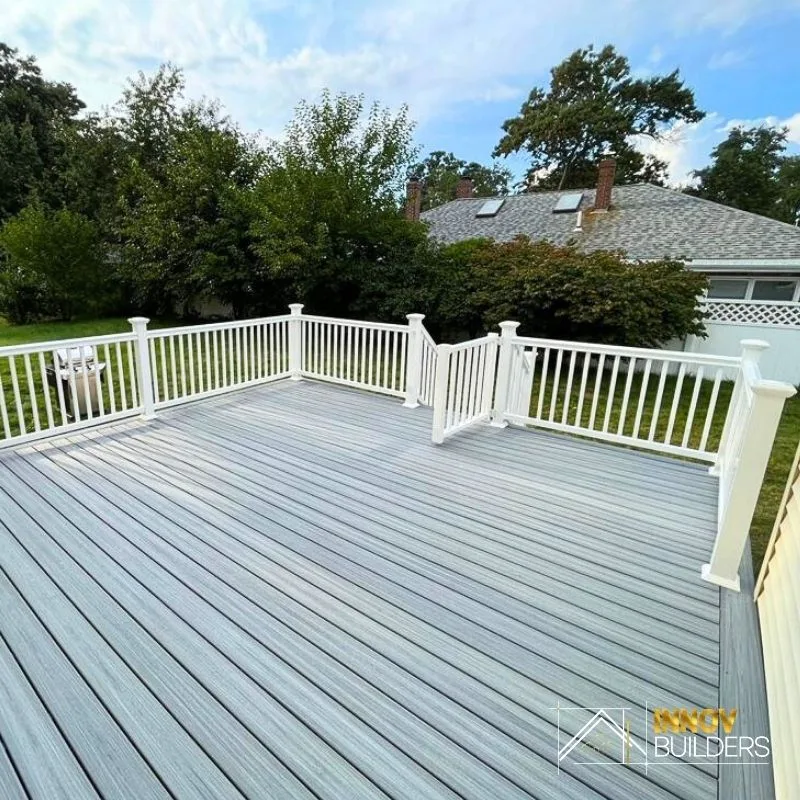
If you are comparing deck builders Reading, MA homeowners can trust with the whole job, Innov Builders designs, permits and builds wood and composite decks across the 01867 zip code from our shop at 50 New Salem St in neighboring Wakefield. We handle new decks, full tear-off rebuilds, railing and stair replacements, and the Town of Reading paperwork that comes with them. To get started, call (978) 788-1690 or request a free deck estimate and we will walk your yard, measure, and send a written, itemized number.
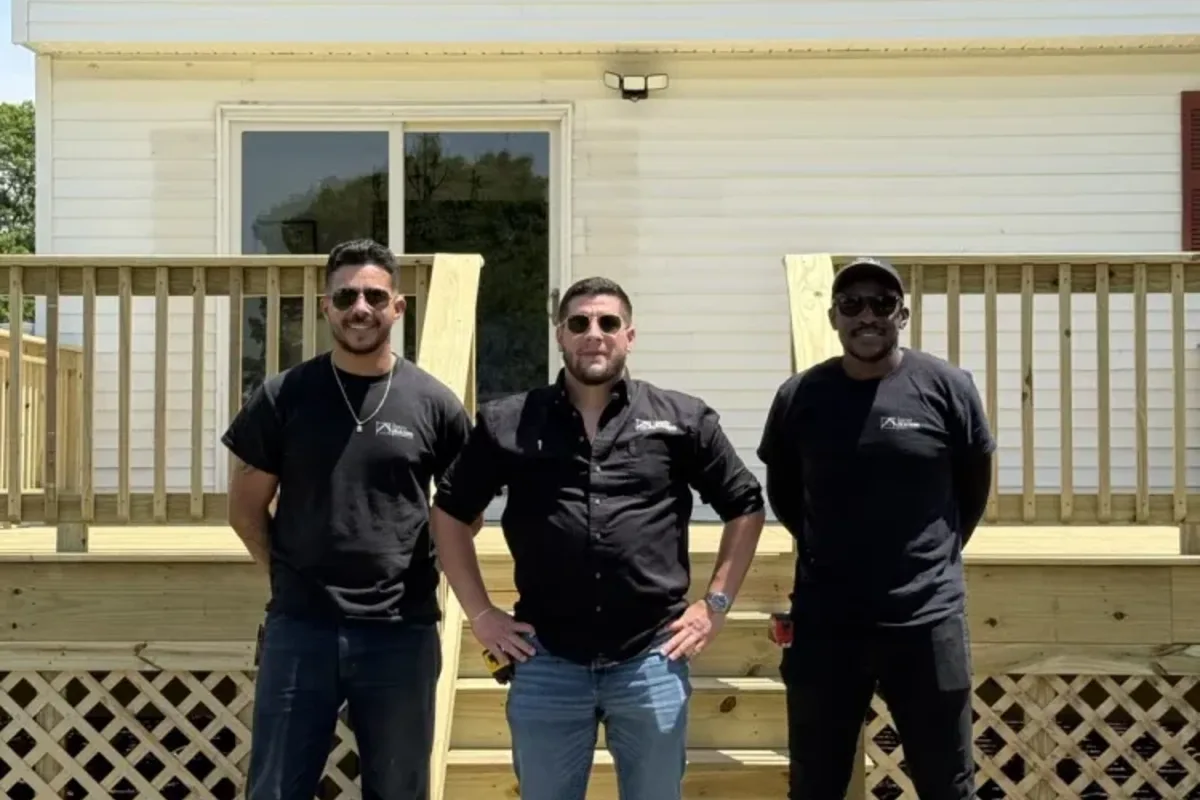
We are a licensed and insured Massachusetts general contractor (HIC #212869, OSHA certified), and the person you meet at the estimate is the same team that frames and finishes the deck. This page is written for Reading specifically. It covers the permit file the Inspectional Services office actually asks for, what the Conservation Commission regulates near the Ipswich River and the Aberjona headwaters, the setback numbers in Reading's single-family zoning districts, how the local historic districts treat outdoor stairs, and what a deck tends to cost on the kinds of houses Reading is full of. Whether you call it a deck builder, a deck contractor or simply someone to do your deck building in Reading, MA, the goal is the same: a structure that passes inspection the first time and still feels solid in twenty winters.
A Reading deck we have already rebuilt
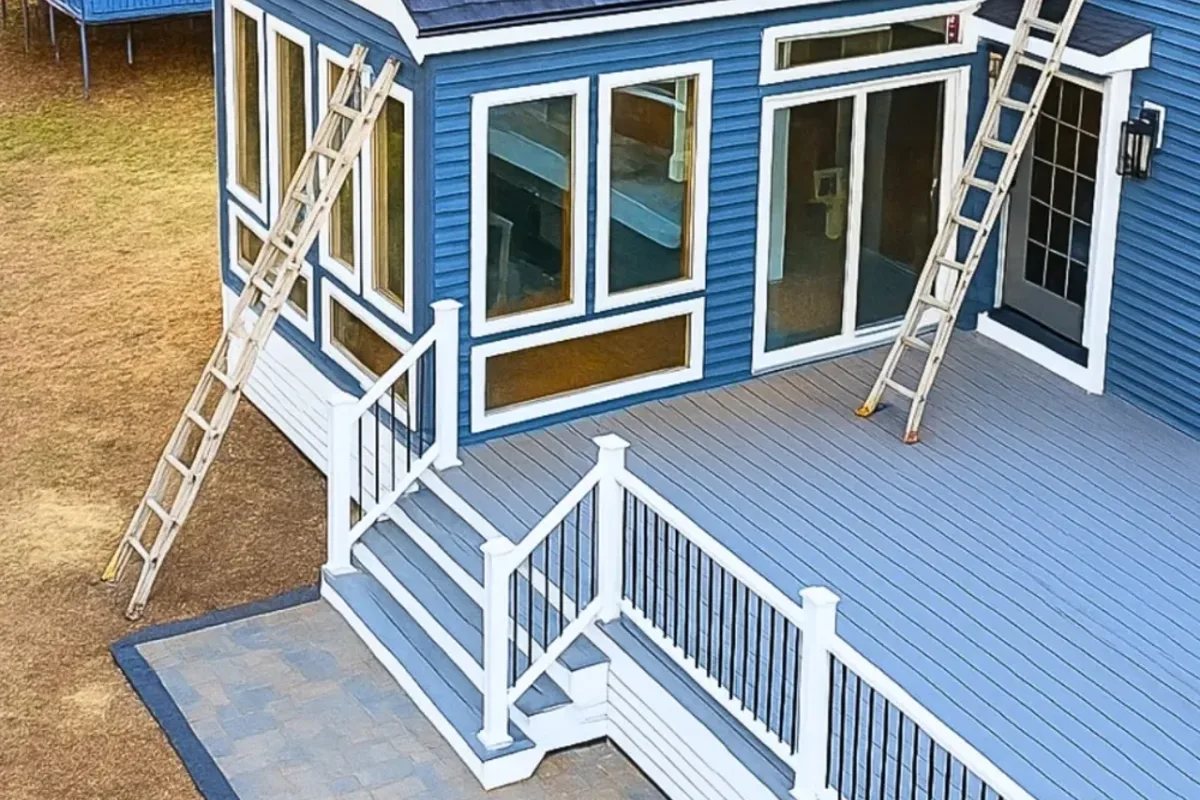
Reading is not a new market for us. Our project portfolio includes a deck remodel in Reading, MA where the old structure was removed and rebuilt from the ground up with new decking, new railings and new stairs. That is the most common Reading request we get: a deck that went in decades ago, has been patched a few times, and is now soft underfoot or wobbly at the rail. Pulling it off completely lets us see the ledger connection and the footings instead of guessing about them.
We have done the same full rebuild in nearby Burlington, Winchester and Tewksbury, and further out in Swampscott, Wellesley and southern New Hampshire. Each of those jobs followed the same rule we apply in Reading: nothing old stays in the structure unless we have inspected it and can defend keeping it.
How the typical Reading house decides what kind of deck you can build
Before we talk about boards or colors, we look at the house, because in Reading the house dictates the deck. According to housing data compiled by NeighborhoodScout, roughly 37 percent of Reading's homes were built between 1940 and 1969, about 27 percent predate 1940, and around 21 percent went up between 1970 and 1999. Single-family detached homes make up about 71 percent of the housing units in town. In practice that means three families of houses show up again and again on our estimates.
Post-war capes and ranches
The capes and ranches from the 1940s through the 1960s usually sit low to the ground, with a back door only a step or two above grade. These homes rarely need a tall deck. They need a low platform that lines up with the threshold, drains well, and does not trap moisture against old sill plates. The challenge is often the rim joist: on a house of that age, it may never have been designed to carry a ledger, so we check it carefully before we bolt anything to it.
Older colonials and Victorians near the center of town
The pre-1940 houses closer to Reading Square and along the older streets tend to have taller foundations, a kitchen floor several feet above the yard, and trim details worth respecting. A deck here often becomes a raised structure with a real stair run, and the design question is how to keep it from looking like an add-on hung off the back of a period home.
Splits, garrisons and later colonials
Houses from the 1970s through the 1990s, including split-levels and garrison colonials, frequently have a slider on the upper level and a walkout or partial walkout below. That is where second-story decks, under-deck space and multi-level layouts make sense.
Low platform decks for Reading ranches and capes
A low deck sounds simple, and it is where a lot of Reading decks go wrong. When the framing sits a foot or less above the soil, air barely moves underneath, leaves and pine needles collect, and the joists stay damp for weeks after a storm. Many of the shaded, tree-lined lots around Reading make that worse.
On these builds we take a few specific steps:
- Ground prep first: we clear organic material, grade the soil away from the house, and lay landscape fabric and stone under the frame so the space stays drier and weeds stay out.
- Ground-contact rated lumber: framing that sits close to grade gets lumber treated for ground contact, not the above-ground grade that is fine on a taller deck.
- Joist tape on the framing: a strip of butyl tape over the top of each joist keeps water from sitting in the fastener holes, which matters more when the frame dries slowly.
- Threshold math: we set the deck surface just below the door sill so snow melt does not run into the house, a detail that is easy to miss on a ranch with a low back door.
A one-step platform off a Reading cape is often the most affordable way to add real outdoor living space, and because it is close to the ground, many of them do not need a guard at all. They still need a permit when the Town's checklist calls for one, and we confirm that during the estimate.
Second-story and walkout decks on Reading colonials and splits
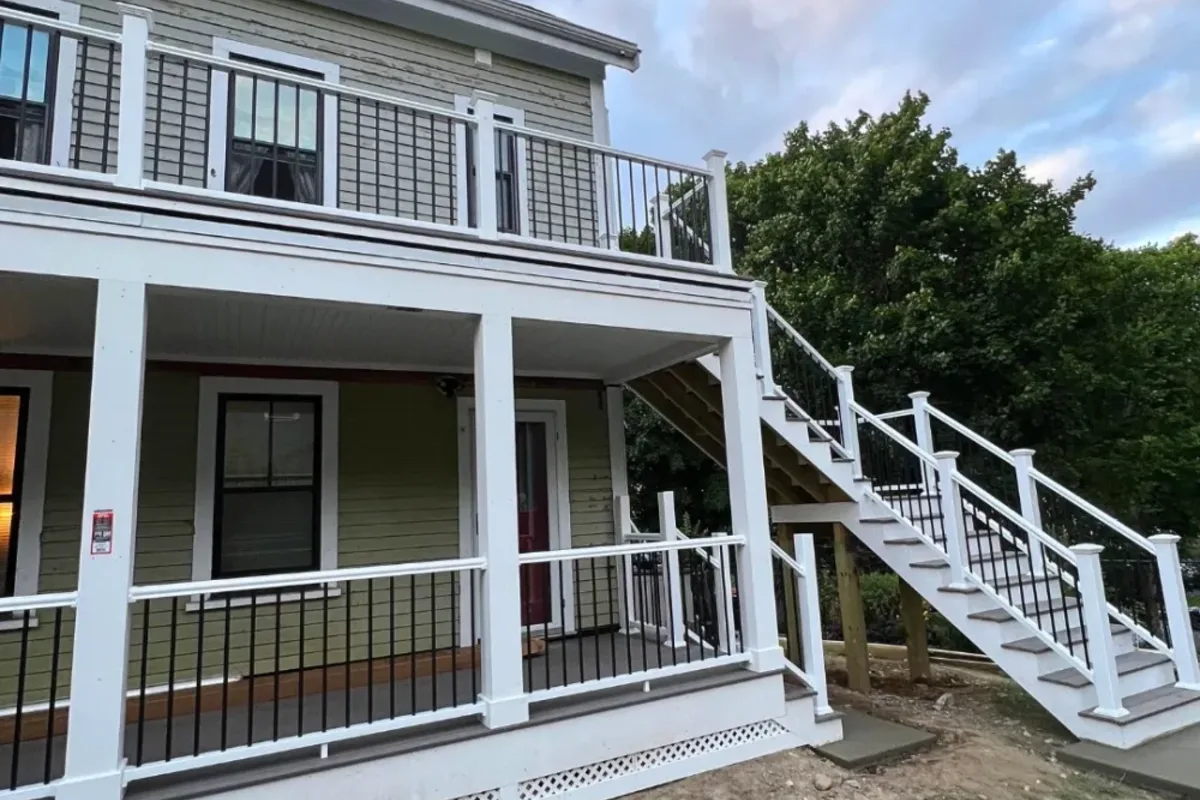
When the kitchen or family room is eight to ten feet above the yard, the deck becomes a structural project in the full sense. The ledger has to be through-bolted to the house framing, flashed so water cannot get behind it, and backed up with lateral load connectors where the design calls for them. Posts need to be sized for the height, beams need to span correctly, and the stair needs a landing and a guard that works for the whole run.
These are also the decks where the space underneath deserves a plan. On a walkout split in Reading, we can leave the underside open for storage, add lattice or vertical board skirting, or install an under-deck drainage system that keeps a patio below dry. Deciding that up front changes where posts go, so it is part of the design conversation, not an afterthought.
Not sure which of these fits your house? We will tell you at the site visit, in writing. Call (978) 788-1690 or request a free deck estimate and we will schedule a time to look at your Reading yard in person.
The Reading permit file, item by item
Reading handles building permits through its Inspectional Services office in the Building Division at 16 Lowell Street, and applications go through the Town's online portal, ViewPoint Cloud. The Town publishes a checklist for residential building permits, and decks are listed alongside additions, garages and in-ground pools. Here is what that checklist asks for on a deck, and who on our side prepares it.
| Checklist item (Town of Reading) | What it means for your deck | Who handles it |
|---|---|---|
| Two certified plot plans | A plan showing exactly where the deck sits on your lot relative to property lines | We coordinate it; a surveyor may be needed if you have no recent plan |
| Two sets of building plans | Framing layout, footing locations, beam and joist sizes, ledger and stair details | Innov Builders |
| Prescriptive Residential Wood Deck Construction Guide | The industry deck guide the Town references for wood deck framing and connections | Innov Builders designs to it |
| Conservation approval | Sign-off from the Conservation Division when the lot is near a wetland, stream or floodplain | We check the Town wetland map and file if needed |
| Fire Department approval of plans | Plan review by the Reading Fire Department | Routed with the application |
| Signed contract, CSL, HIC registration, workers comp affidavit, certificate of insurance | Proof the contractor is licensed, registered and insured, uploaded with the application | Innov Builders |
Two details on that checklist are worth knowing. First, the permit has to be issued and posted at the property before work begins, so a contractor who offers to start next week and sort out the paperwork later is asking you to take a risk. Second, the Town notes that the Building Inspector may require professionally stamped plans, so an unusually tall deck, a long clear span or a hot tub load can mean an engineer's stamp. We flag that during design so it does not surprise you halfway through review.
The Town does not publish a single flat deck fee on that checklist, and fees are set by the Town, so we give you the current figure when we prepare your application rather than quoting a number here.
Who reviews a deck in Reading besides the building inspector
A deck application in Reading can touch more than one office. Knowing which ones apply to your address is the difference between a smooth approval and a stalled one.
Building Division
The Building Commissioner's office reviews the structural plans and performs the inspections. The Town notes that a building permit must be picked up before an inspection can be scheduled. For a typical deck we plan on a footing inspection before concrete, a framing inspection before the decking hides the structure, and a final inspection once the rails and stairs are complete.
Conservation Division
The Conservation Commission reviews work near wetland resource areas, covered in more detail in the next section. Its office is in the same Town Hall building on Lowell Street.
Fire Department
The Town's checklist lists Fire Department approval of plans for deck applications, so we route the drawings accordingly.
Electrical inspector, when lighting is involved
If your deck includes post lights, stair lights or a new outdoor outlet, a licensed electrician pulls a separate electrical permit, and Reading's electrical inspector schedules early-morning inspections. We coordinate that trade inside our schedule so you are not chasing two contractors.
Building a deck near the Ipswich River, the Aberjona headwaters or a Reading wetland
Reading has more water on the map than most people realize. The Ipswich River forms the town's northern boundary and runs through the Reading Town Forest. The Aberjona River starts in Reading, and the Town has invested in the Aberjona River Headwaters Trail through the Maillet Conservation Area between Lowell Street and Willow Street. There are also numerous vernal pools on conservation land and a Town wetland map that shows how many backyards sit near a regulated resource.
According to the Reading Conservation Division, the Conservation Commission regulates work within 100 feet of a wetland, lake or pond, within 200 feet of a river or stream, and within the 100-year floodplain. The Town specifically lists decks, patios and additions as projects that need prior approval when they fall inside those areas. Reading also adopted updated local Wetlands Protection Regulations in 2023.
What this means in practice for your deck:
- We check the map before we design. If your lot is near the Town Forest, a brook, a pond or a mapped wetland, we look at it at the first visit so the design, the schedule and the budget account for a conservation filing.
- Footing work is the sensitive part. Digging holes, stockpiling soil and moving equipment are what the Commission cares about, so we plan erosion controls and keep spoils away from the resource area.
- Timing changes. A conservation review can add weeks before the building permit is finalized, especially if a hearing is required. We build that into the calendar instead of promising a start date we cannot keep.
- Your lot size may already reflect this. Reading's zoning bylaw only credits wetland area toward minimum lot size when enough upland remains (12,000 square feet in the S-15 and S-20 districts, 20,000 in S-40), which is a clue that many Reading lots have less usable yard than their total acreage suggests.
Wet spring soil near these areas also affects construction. Yards close to the river or a wetland often stay saturated into May, so we sometimes schedule footing work for a drier window and use footing systems that suit soft ground.
Setbacks and lot coverage on Reading's S-15, S-20 and S-40 lots
Most single-family homes in Reading sit in one of three zoning districts: S-15, S-20 or S-40, named for their minimum lot sizes of 15,000, 20,000 and 40,000 square feet. The Town's Table of Dimensional Controls sets the same yard requirements across all three for a one- or two-family home: a 20-foot front yard, a 15-foot side yard, a 20-foot rear yard, and a maximum building coverage of 25 percent of the lot.
A deck that stays comfortably inside those lines is straightforward. Trouble starts on narrow lots, corner lots and houses that were already built close to a side line decades ago. The bylaw also has separate rules for accessory structures within required side and rear yards, including a five-foot minimum from the lot line and a cap on how much of that yard they can occupy. How a specific deck is classified is the Building Commissioner's call, so we lay the design on your certified plot plan early and confirm the approach before you commit to a size. If a design would need zoning relief, you hear that from us at the design stage, not from the Town after you have paid a deposit.
Decks inside the West Street and Summer Avenue historic districts
Reading has two local historic districts, West Street and Summer Avenue, overseen by a five-member Historic District Commission. The Commission's design guidelines list the exterior items it most often reviews when they can be seen from a public way, and outside stairs and roof decks are on that list. Terraces and walks that sit substantially at grade are exempt, and ordinary maintenance and repair is exempt as long as it does not change the materials, design or size of the feature.
For a homeowner in either district, that usually works out like this: replacing a few rotted boards in kind on a deck hidden behind the house is maintenance, while a new raised deck with a visible stair, or a rebuild that changes the look of a structure seen from the street, may need Commission review before the building permit. We check your address against the Town's district property lists and, when review applies, prepare drawings and material samples that respect the house. Painted wood rails, simple square balusters and trim that echoes the existing house tend to fit these streets better than a glossy all-composite system.
Condo and townhouse decks in Reading
Not every Reading homeowner owns the ground under the deck. Developments like Summit Village, a 132-unit condominium community built in 1996, and other associations around town typically control exterior changes through their master deed and rules. In those communities the first approval is the association's, not the Town's.
For condo owners we start by asking for the association's written requirements: approved materials, colors, railing style and who is responsible for the structure versus the surface. Some associations replace decks themselves on a schedule; others let owners hire their own licensed contractor. We can provide drawings, insurance certificates and our HIC registration to the board so the approval moves quickly, then pull the Town permit once the association signs off.
What a deck costs in Reading, MA
Every Reading deck is priced from the site, but homeowners deserve a realistic starting point. The ranges below are estimates for the Reading area in 2026, based on typical scopes we see, and they include permit coordination, demolition where listed, and standard railings and stairs. Your actual number depends on size, height, material, access and what we find when the old structure comes off.
| Project | Typical size | Estimated range | What moves the price most |
|---|---|---|---|
| Low platform deck, pressure-treated | about 12 x 14 ft | $9,000 to $16,000 | Ground prep, drainage, whether a guard is required |
| Low platform deck, composite | about 12 x 14 ft | $14,000 to $22,000 | Board line, picture framing, hidden fasteners |
| Raised deck off a colonial or split, composite | about 14 x 16 ft | $24,000 to $40,000 | Height, beam and post sizing, stair run and landing |
| Tear-off and full rebuild with new rails and stairs | about 250 to 350 sq ft | $28,000 to $50,000 | Condition of ledger and rim, footing replacement |
| New railings and stairs on a sound frame | per deck | $4,000 to $12,000 | Railing system chosen, number of stair runs |
| Resurface: new decking on an inspected frame | about 250 sq ft | $10,000 to $20,000 | Frame repairs found, board material |
These figures are estimates, not quotes. We send every Reading homeowner an itemized written estimate that separates structure, decking, railings, stairs, permit-related costs and any allowances, so you can see where the money goes and adjust scope before you sign.
Where Reading deck budgets tend to grow
Most cost surprises on a Reading deck come from the same handful of places. We price for them honestly or call them out as allowances so nobody is caught off guard.
- The rim joist behind the ledger. On a 60- or 70-year-old house, the band board behind an old deck is often stained, soft or split from years of trapped water. It has to be repaired before a new ledger goes on.
- Lead paint on older trim. Reading homes built before 1978 may have lead paint on the siding or trim we disturb when we remove a ledger. We follow lead-safe work practices, which adds time and containment.
- Old footings that do not qualify. Shallow or undersized piers from an older deck usually cannot be reused and have to be replaced.
- Tree roots and ledge. Mature trees are one of the best things about Reading yards, but big roots or buried stone can move a footing location or require different equipment.
- Engineering or conservation requirements. A stamped plan or an erosion control plan near a wetland is a real line item, and we identify the need early.
The fastest way to know your real number is to have us look at it. Call (978) 788-1690 or request a free deck estimate. The visit and the written estimate are free, and there is no pressure to sign.
Reuse the old footings or start over?
It is a fair question, because reusing a structure saves money on paper. On the Reading decks we open up, the answer depends on what we find:
- We expose the footings. If they are poured concrete piers that reach proper frost depth, are sized for the load, and sit where the new framing plan needs them, they may stay.
- We check the posts and beam. Posts buried in soil or set directly in concrete often rot at the base. Those get replaced even when the pier is fine.
- We look behind the ledger. Missing flashing, nails instead of bolts, or a ledger fastened through siding means the connection comes apart and gets rebuilt correctly.
- We compare against current code. A deck that was acceptable when it was built may not match what the inspector expects today, particularly at the ledger, the guards and the stairs.
In our experience most Reading decks older than about 25 years end up as full rebuilds, which is exactly what our Reading portfolio project was. When a frame is genuinely sound, we will tell you and price a resurface instead.
Choosing decking for a shaded Reading yard versus a sunny one
Reading has a lot of mature trees, and conservation land like the Town Forest and Bare Meadow sits close to many neighborhoods. That matters for decking more than most people expect, because shade and leaf litter decide how a surface ages.
| Material | In a shaded, tree-covered Reading yard | In an open, sunny Reading yard |
|---|---|---|
| Pressure-treated pine | Lowest cost, but stays damp longer and needs regular cleaning and sealing | Dries fast; expect checking and graying without a stain every few years |
| Cedar | Handsome and naturally resistant, yet prone to mildew where sun never reaches | Weathers to silver; needs periodic oil or stain to hold its color |
| Capped composite | Resists staining from tannins and pollen and rinses clean | Holds color well; darker colors get hot underfoot in July |
| PVC decking | Very low moisture absorption, a good fit near wetlands and damp lots | Lightest colors stay coolest; premium price |
For the damp, shaded lots common near Reading's conservation areas, we often recommend a capped composite or PVC surface on a pressure-treated frame protected with joist tape. For a sunny back yard where budget comes first, a well-built pressure-treated deck with a good stain schedule can serve you for many years. We bring samples to the estimate so you can see them against your house and your light.
Railings, stairs and connections: what inspectors look at hardest
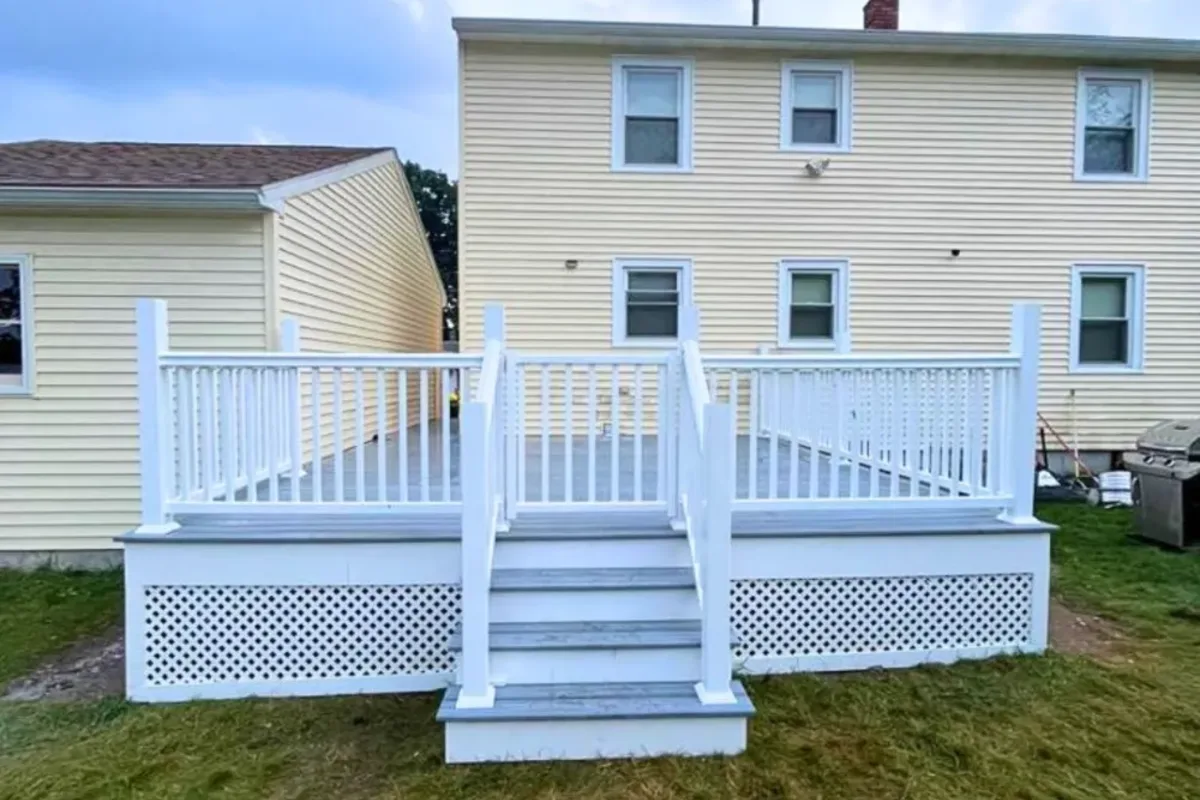
On a deck inspection, the boards are the least interesting part. Inspectors spend their time on the pieces that keep people from falling and keep the deck attached to the house. We build those to the Massachusetts State Building Code, which is based on the International Residential Code:
- Guards: required where the walking surface is more than 30 inches above grade, at a minimum height of 36 inches for residential decks, with openings small enough to stop a 4-inch sphere.
- Stairs: consistent riser heights and tread depths from top to bottom, a graspable handrail on stairs with four or more risers, and a solid landing at the bottom instead of a stringer resting on soil.
- Ledger: bolted, not nailed, into solid house framing, with flashing that sheds water over the top and away from the rim.
- Posts and beams: proper post-to-beam hardware and bracing sized for the height, especially on second-story Reading decks.
- Stair lighting: not always required, but on a Reading winter evening a lit stair is one of the cheapest safety upgrades you can add.
For a closer look at interior and exterior stair work, see our guide to stair remodeling in Reading.
Snow, freeze-thaw and footing depth north of Boston
Reading sits about 16 miles north of downtown Boston, and its winters bring the full New England cycle: snow that piles on a deck for weeks, rain on top of it, and repeated freezing and thawing. Every part of the structure has to respect that.
Footings go below the frost line, which in eastern Massachusetts means roughly four feet down, so frost heave cannot lift a post in February and drop it in April. Framing is sized for the snow load the code requires, not just for a summer party. We space and fasten boards so meltwater drains through instead of pooling, and we keep the deck surface below the door sill so drifting snow does not become a leak into the kitchen. If you plan to shovel your deck, tell us: it changes our advice on board material and on fastener style.
Timeline: permits first, then a short build
Homeowners are often surprised that the paperwork can take longer than the construction. A realistic Reading deck calendar looks like this:
| Phase | Typical length | Notes for Reading |
|---|---|---|
| Site visit and written estimate | About 1 week | Includes a look at the wetland map and your plot plan |
| Design and permit package | 1 to 2 weeks | Plot plan, framing plans, contractor documents uploaded to ViewPoint Cloud |
| Town review | Varies | Longer if Conservation or Historic District review applies |
| Demolition and footings | 2 to 4 days | Footing inspection before concrete |
| Framing, decking, rails and stairs | 1 to 3 weeks | Framing inspection before decking covers the structure |
| Final inspection and walkthrough | 1 to 3 days | Deck is ready to use once it passes |
Spring is the busiest season for decks, so Reading homeowners who want to be outside by early summer do well to start the design over the winter. Fall is an excellent time to build: crews and materials are easier to schedule, and the ground is usually firm.
How we run a deck job in Reading
- Walk the property. We look at the house, the door heights, the slope, the trees, access for equipment and any nearby water or wetland.
- Design with you. Size, shape, stairs, material and railing are settled on paper with a written, itemized price.
- Assemble the permit file. Plot plan, framing plans and our license, registration and insurance documents go into the Town's portal, plus any conservation or historic filing.
- Protect the yard. Before demolition we set protection for lawns, plantings and siding, and erosion controls where the lot calls for them.
- Build and inspect in stages. Footings, framing and final each get their inspection before we close anything up.
- Walk it together. We go over the finished deck with you, explain care for the material you chose, and leave the site clean.
Problems we find on older Reading decks
These are the issues we see most often when we are called to look at an existing deck in town, usually one built by a previous owner or a crew that is long gone:
- Ledgers nailed through siding with no flashing, leaving a line of rot along the house rim.
- Posts sunk directly in the ground, soft at the base after a couple of decades in Reading's damp soil.
- Stairs with uneven risers because the grade under them settled over time.
- Guards added after the fact and screwed to the outside of the rim, which loosen as soon as someone leans on them.
- Undersized beams that sag in the middle of a span, often noticeable after a heavy snow winter.
- Decks built without a permit, which can surface as a problem when the house is sold and the buyer's inspector asks for records.
If you recognize one of these on your deck, it is worth having it looked at before summer. Many can be fixed without a full rebuild; some cannot, and it is better to know.
Questions to ask any deck contractor in Reading before you sign
Whoever you hire, these questions separate a professional from someone who will leave you with a problem:
- Are you registered as a Massachusetts Home Improvement Contractor, and can I see your HIC number and construction supervisor license?
- Who pulls the Reading building permit, and will it be posted before you start?
- Is the design based on the prescriptive deck construction guide the Town lists, or will it need an engineer?
- Have you checked whether my lot is within the Conservation Commission's jurisdiction or a local historic district?
- How deep will the footings go, and how will the ledger be attached and flashed?
- Are you insured, and will you provide a certificate of insurance and a workers compensation affidavit?
- Is your crew in-house, and who is on site day to day?
- What does your written warranty cover, and for how long?
Massachusetts homeowners also have protections under the state's home improvement contractor law, including the Guaranty Fund, when they work with a registered contractor. That protection does not apply if you hire someone who is not registered, which is one more reason to ask for the HIC number up front. Ours is #212869.
Decks as part of a larger Reading renovation
A deck rarely stands alone. In Reading we often build one alongside another project, and planning them together saves money and produces a better result. A home addition in Reading almost always changes where the back door lands, so the deck should be designed at the same time. A finished basement with a walkout can turn the space under a raised deck into a covered patio. A new kitchen with a slider, like the projects on our Reading kitchen remodeling page, is the natural moment to connect the inside to a deck outside.
We have combined outdoor and indoor work before. In Andover, for example, we built a sunroom addition together with a deck. Because we are a full general contractor, one team handles the permits, the framing and the finish for both.
From our Wakefield shop to your Reading street
Reading borders Wakefield, so our crew is close to every part of town, from the neighborhoods around Birch Meadow and the Wood End side of Reading to the streets near Reading Square and the commuter rail station. The I-93 and I-95/Route 128 interchange sits in Reading, which also makes it easy for material deliveries to reach your job on schedule.
If you have friends or family in neighboring towns, we build there too. See our pages for deck builders in Wakefield, MA, deck builders in North Reading, MA, deck builders in Lynnfield, MA and deck builders in Woburn, MA, or browse our full deck and porch services. Just make sure your address is Reading, MA 01867 and not North Reading or Reading, Pennsylvania: the rules on this page apply to the Town of Reading in Middlesex County only.
Planning more space or an outdoor upgrade in Reading too? Start with built-in cabinets in Reading, MA.
Book a free deck estimate in Reading, MA
If your deck is soft, loose at the rail, older than your kids, or simply too small for how your family lives, we would like to see it. Innov Builders is licensed and insured (HIC #212869, OSHA certified), led by owner Iago Maciel, and we have already rebuilt a deck in Reading. Call (978) 788-1690 or request a free deck estimate and we will schedule a visit, check your lot against the Town's requirements, and send you a written, itemized estimate.